
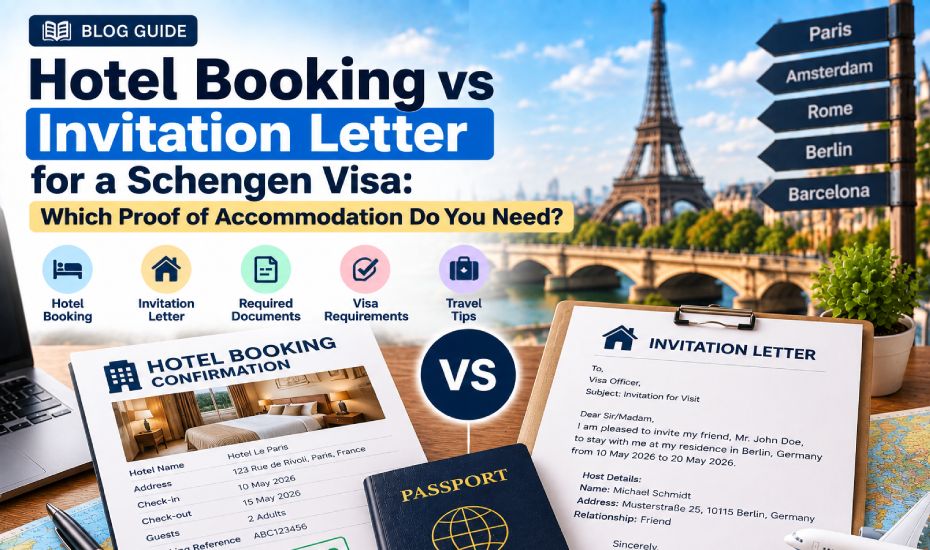
Planning a trip to Europe involves more than deciding which cities to visit. Before submitting a Schengen visa application, you also need to establish where you intend to stay during your visit. Depending on your travel arrangements, this may involve a hotel reservation, an invitation from a friend or relative, or another form of accommodation evidence accepted by the relevant consulate.
Understanding the requirements for Proof of Accommodation for Schengen Visa applications can help you choose the right documents from the beginning. A hotel booking may be appropriate for an independent holiday, while an invitation and supporting documents may be more suitable if you plan to stay with family or friends.
If you intend to stay in hotels and need to arrange your travel documents quickly, Schengen Visa Flight Reservation offers a dedicated hotel booking for visa service for applicants preparing their accommodation documentation. Before choosing any service, make sure the reservation reflects your genuine travel plans and meets the requirements of your visa application.
The important question is not which document looks better. It is which type of accommodation evidence accurately represents your trip and satisfies the applicable visa requirements.
This guide compares hotel bookings with invitation letters, explains when each option may be appropriate, and shows how to prepare your accommodation documents for a Schengen visa application in 2026.
Why Does a Schengen Visa Application Require Accommodation Proof?
When reviewing a visa application, the relevant authorities need to understand the applicant's proposed stay. Accommodation information helps establish where the traveler intends to live during the visit and whether the arrangements make sense alongside the proposed itinerary.
For example, imagine that you plan to spend ten days in France and Italy. Your application states that you will spend six nights in Paris and four nights in Rome. Accommodation documents supporting those dates help explain how you intend to organise the trip.
Now consider a different applicant who plans to stay with a sibling in Germany for two weeks. A hotel booking may not accurately represent that person's arrangements. An invitation from the host and the supporting documents required by the relevant authority may be more appropriate.
Both applicants need to explain their accommodation plans, but their circumstances are different.
Accommodation proof is only one part of the application. It does not guarantee visa approval, and the required supporting documents may vary according to the applicant's circumstances and the destination country's procedures.
Hotel Booking vs Invitation Letter: What Is the Difference?
The main difference is the type of accommodation you intend to use.
A hotel booking indicates that you have arranged or proposed a stay at a commercial accommodation property. An invitation letter explains that a host, such as a friend or relative, intends to accommodate or invite you.
| Factor | Hotel Booking | Invitation Letter |
|---|---|---|
| Suitable situation | Staying at a hotel or other commercial accommodation | Staying with a friend, relative, or another host |
| Main purpose | Shows proposed accommodation details | Explains the host's invitation and accommodation arrangement |
| Typical information | Property name, address, guest details, stay dates | Host details, applicant details, relationship, visit dates |
| Additional evidence | Booking confirmation and other required documents | Host's address evidence or sponsorship documents, if required |
| Flexibility | Depends on booking and cancellation terms | Depends on the host's arrangements and applicable requirements |
Neither option is automatically better in every situation. The correct choice depends on where you will actually stay and what the relevant visa authority requires.
Option 1: When Should You Use a Hotel Booking?
A hotel reservation is generally the more straightforward option when you intend to pay for your own accommodation.
This is common for tourists, couples, solo travelers, and families visiting Europe for sightseeing or holidays.
Suppose you plan to visit France for eight nights. You intend to stay at a hotel in Paris for five nights before travelling to Lyon for another three nights.
Your accommodation plan could look like this:
- Paris: 5–10 September
- Lyon: 10–13 September
Your hotel documentation should support those dates and locations.
What Should a Hotel Reservation Include?
Depending on the booking format and the applicable requirements, check whether the confirmation identifies:
- The guest or lead traveler's name
- Hotel or accommodation property's name
- Property address
- Check-in and check-out dates
- Number of guests
- Booking or confirmation details
If several family members are travelling together, check whether the reservation correctly represents the accommodation arrangement and the number of guests.
Do You Need to Pay for the Entire Hotel Stay?
Not necessarily. This depends on the booking arrangement and the requirements applicable to your visa application.
Some hotels offer flexible cancellation conditions, while others require prepayment or impose cancellation charges. Read the terms before making a payment.
A reservation should accurately represent the accommodation you intend to use. Do not assume that every booking can be cancelled without a fee or that every temporary reservation will meet the relevant authority's requirements.
Option 2: When Should You Use an Invitation Letter?
An invitation letter may be appropriate when you plan to stay with a friend, relative, or another host instead of booking a hotel.
For example, imagine that your cousin lives in Amsterdam and has invited you to stay at their home for twelve days. In that situation, a hotel booking would not accurately represent your intended accommodation if you genuinely plan to stay with your cousin.
The appropriate documentation may include an invitation letter and additional evidence relating to the host or accommodation.
The exact requirements depend on the country handling the application, your circumstances, and whether the host is simply providing accommodation or also sponsoring your visit.
What Information May an Invitation Letter Include?
Depending on the relevant requirements, the letter may identify:
- The host's full name
- The host's address
- The applicant's full name
- The relationship between the host and applicant
- The intended visit dates
- The purpose of the visit
- Whether accommodation or financial support is being provided
The host may also need to provide proof of address, identification, or other supporting documents.
Some countries or circumstances require a formal sponsorship or accommodation declaration. An ordinary invitation letter may not be sufficient in those cases.
Does the Host Need to Be a Family Member?
Not necessarily. A friend or another eligible host may invite a traveler, subject to the applicable requirements.
However, the applicant should accurately explain the relationship and the reason for the visit. The documentation must reflect the genuine arrangement rather than an accommodation plan created only for the application.
A Realistic Example: Two Travelers, Two Different Accommodation Plans
Consider two applicants travelling to Europe in October 2026.
Applicant A: Independent tourist
Priya plans to spend seven nights in France. She will pay for her own hotel and has selected accommodation in Paris.
Her documents should reflect her actual hotel arrangements and intended dates.
Applicant B: Family visit
Arjun plans to spend ten nights in Germany with his sister, who lives in Berlin.
His accommodation plan is based on staying at her home. He should follow the applicable requirements for an invitation and any additional host documentation.
Neither applicant needs to copy the other's approach. Their accommodation evidence should reflect their real travel arrangements.
Can You Use Both a Hotel Booking and an Invitation Letter?
Yes, when your trip genuinely includes both types of accommodation.
For example, you may stay with a friend in Paris for four nights and then move to a hotel in Rome for five nights.
Your proposed accommodation plan could be:
| Destination | Dates | Accommodation |
|---|---|---|
| Paris, France | 3–7 October | Staying with a friend |
| Rome, Italy | 7–12 October | Hotel |
| Departure | 12 October | Return journey |
In this situation, the invitation documents should support the stay in Paris, while the hotel confirmation should support the stay in Rome.
Your itinerary and other supporting documents should explain the complete journey. Check whether additional documents are required for either part of the stay.
Using two accommodation types is not inherently a problem. The key is that each document should relate to the correct part of the trip.
What If Your Hotel Booking Does Not Cover Every Night?
An accommodation gap does not automatically mean that your application will be refused, but you should understand why the gap exists and provide appropriate evidence.
Suppose your flight arrives in Paris on 3 October, but your hotel reservation starts on 5 October.
Ask yourself where you will stay on 3 and 4 October.
Perhaps you will stay with a friend, or you may have another accommodation arrangement. If so, make sure the supporting documents accurately reflect it and meet the applicable requirements.
The same applies to the end of the trip. If your hotel check-out date is earlier than your return flight, you should have a clear explanation for the remaining period.
Review the full itinerary before submitting your application rather than checking each reservation separately.
How Should Your Hotel Booking Match Your Flight Itinerary?
Your flight and accommodation documents should create a logical timeline.
Imagine your proposed trip is:
- Arrival in Paris: 5 November
- Hotel stay in Paris: 5–9 November
- Train journey to Brussels: 9 November
- Hotel stay in Brussels: 9–12 November
- Return flight: 12 November
This is a clear itinerary because the accommodation dates correspond with the planned movements between destinations.
Now imagine your hotel reservation in Brussels starts on 11 November, although your itinerary says you arrive on 9 November. You should review those dates and correct any errors before submission.
If you intend to stay somewhere else for the first two nights, your documents should explain that arrangement appropriately.
Your travel insurance dates should also be checked against the intended journey and the applicable visa requirements.
What If You Are Applying for a Schengen Visa for Multiple Countries?
Multi-country trips require a little more planning because the applicant needs to explain where they will stay in each destination.
For example, a fourteen-day trip could include:
- France: 1–5 June
- Switzerland: 5–9 June
- Italy: 9–15 June
Your accommodation documents should support the proposed stay in each country. If you are staying with friends for one part of the trip and in hotels for the rest, make sure the documents accurately represent each arrangement.
Applicants travelling to multiple Schengen countries should also check the rules for determining the appropriate country in which to submit their visa application. The main destination is generally determined by the principal purpose or, for a uniform tourism itinerary, the country where the applicant intends to spend the longest time, subject to the applicable rules.
If the stays are equal or the circumstances are more complicated, follow the official guidance for your application.
What If Your Accommodation Plans Change After Booking?
Travel arrangements sometimes change. A hotel may become unavailable, a host may no longer be able to accommodate you, or your intended travel dates may move.
If this happens before you submit your application, update your documents so they reflect your current plans.
If your application has already been submitted, check the instructions provided by the relevant consulate or visa application centre before making changes or sending additional documents.
Before submitting any updated accommodation information, review:
- Your arrival and departure dates.
- The new hotel or host address.
- The accommodation period.
- The flight itinerary.
- Any insurance or application details affected by the change.
Do not submit an old reservation that no longer represents your intended stay simply because it is already available as a PDF.
Common Accommodation Proof Mistakes to Avoid
1. Choosing Accommodation That Does Not Reflect Your Real Plans
If you intend to stay with family, your documentation should explain that arrangement. If you plan to stay in a hotel, provide the relevant hotel evidence.
2. Incorrect Dates
Check the hotel dates against your flight itinerary and the overall length of your trip.
3. Missing Nights
Make sure every part of the proposed stay has a reasonable accommodation plan.
4. Incorrect Guest Details
Review names and the number of travelers, particularly for family applications.
5. Ignoring Host Documentation Requirements
An invitation letter may need to be accompanied by proof of address, identification, or a formal accommodation or sponsorship declaration, depending on the circumstances.
6. Overlooking Cancellation Terms
Read the conditions before paying for accommodation. Refunds and changes are subject to the booking terms.
7. Assuming Accommodation Proof Guarantees Approval
A hotel confirmation or invitation letter is only one component of a visa application. Authorities may assess the purpose of travel, financial circumstances, supporting documents, and other relevant factors.
A Simple Checklist Before Submitting Accommodation Proof
Use this checklist to review your documents.
If you are staying in a hotel:
- Hotel name and address are correct.
- Guest details are accurate.
- Check-in and check-out dates are correct.
- The booking reflects the intended stay.
- Cancellation and payment terms are understood.
If you are staying with a host:
- The invitation contains accurate information.
- The host's address is clear.
- Visit dates match the itinerary.
- The relationship and purpose of the visit are explained where required.
- Additional host documentation is included if required.
For either arrangement:
- Flight dates and accommodation dates make sense together.
- No nights are unexplained.
- The visa application reflects the genuine travel plan.
- The current official document checklist has been reviewed.
Frequently Asked Questions
Is a hotel booking mandatory for a Schengen visa?
Not in every situation. Applicants generally need to provide appropriate proof of accommodation, but a hotel booking may not be necessary if they will stay with a host and provide the required alternative evidence.
Can I submit an invitation letter instead of a hotel booking?
This may be appropriate if you genuinely intend to stay with a friend or relative and the relevant authority accepts the invitation and supporting documents for your circumstances. Check the current requirements before submitting your application.
Does an invitation letter need to be notarised?
Not always. Requirements vary by destination country and the nature of the visit. Some situations may require a formal declaration or sponsorship document, so consult the official checklist for your application.
Can I stay with a friend without booking a hotel?
Potentially, yes. You should provide the accommodation evidence required for your circumstances, which may include an invitation letter and proof of the host's address.
Should my hotel dates match my flight dates?
Your accommodation and flight documents should form a logical travel timeline. If the dates differ, make sure the remaining period is covered by a genuine and appropriately documented accommodation arrangement.
Can I change my hotel after submitting my visa application?
Travel arrangements can change, but you should follow the instructions of the relevant visa authority. If a change affects the information in your application, check whether updated documentation is required.
Does a hotel reservation guarantee Schengen visa approval?
No. Accommodation evidence supports the proposed travel plan but does not guarantee approval. The decision depends on the complete application and the applicable requirements.
Final Verdict: Hotel Booking or Invitation Letter?
The right choice depends on where you genuinely intend to stay.
If you plan to pay for a hotel, provide accommodation documentation that accurately reflects your reservation and travel dates. If you intend to stay with a friend or relative, follow the relevant requirements for an invitation and any supporting host documents.
If your trip includes both arrangements, document each part of the stay clearly. Make sure your accommodation details fit your flight itinerary, travel dates, and stated purpose of travel.
For applicants who intend to stay in hotels and need to arrange accommodation documentation quickly, Schengen Visa Flight Reservation is one option to consider. Whatever approach you choose, review the current official checklist and make sure the evidence represents your actual plans.
A well-prepared application does not depend on choosing the most impressive-looking document. It depends on providing accurate, relevant, and consistent evidence for the trip you genuinely intend to take.








Responses (0)