
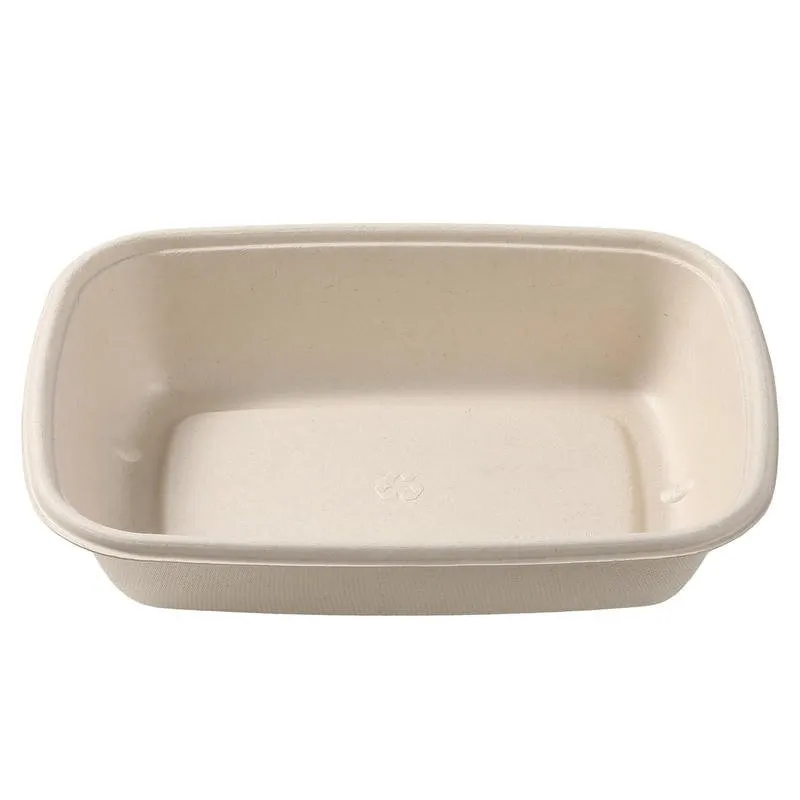
A takeaway box can carry the word “compostable” while ending its life in an ordinary rubbish bin. The label alone does not create a collection system, and not every certified material breaks down under backyard conditions. Buyers researching a Biodegradable Disposable Tableware Manufacturer need to understand the exact claim, the conditions behind it and how the product performs with real food.
Bagasse fibre comes from sugarcane processing, but finished food containers can contain more than fibre. Manufacturers may use additives, treatments or coatings for water and grease resistance. Those components can affect the product's performance and its environmental claims. Ask for a complete description of the relevant food-contact system and supporting documentation for the market in which the packaging will be sold. It is risky to assume that a plant-derived main material makes every finished product suitable for every composting facility.
Certification must be read carefully. Check the test standard, certification body, product scope and validity, rather than copying a logo from a sales presentation. Some schemes address industrial composting conditions, where temperature, moisture and management are controlled. A consumer who puts the same product in a home compost heap may see different results. Local facilities may reject food-soiled items even where the material itself has been assessed under a recognised scheme. Marketing claims should reflect these limits honestly.
Functionality still matters. A bowl carrying hot soup needs resistance to leakage and deformation during the intended serving period. An oily takeaway dish may challenge the surface differently from a dry salad. Test the finished container with representative food, fill level, temperature and holding time. The lid fit, closure and stacking strength can be as important as the bowl wall. Avoid turning a demonstration with cool water into a blanket promise about all hot foods.
Transport and storage deserve practical attention. Fibre products can pick up moisture if packaging is compromised, and nested containers may stick or deform under compression. Run shipping and storage trials that resemble the proposed supply chain. Check whether one-handed opening, lid closure and portion handling are convenient for actual staff. A packaging material has not succeeded merely because it performs in a laboratory or carries an environmental symbol.
Buying teams should separate the environmental impact of material production from the question of what happens after use. A certification for one property does not provide a complete life-cycle comparison with another packaging option. Transport, product weight and whether food waste is captured may all affect the outcome. Avoid sweeping claims such as “zero impact” or “disappears naturally” unless a very specific, credible basis supports them. Customers can make more informed choices with modest, verifiable claims.
Food-contact compliance is also market-specific. The same container may be sent to multiple countries, each with its own documentation expectations. Determine which food types, temperatures and contact durations are covered by relevant test evidence. A test for dry snacks may not justify claims for boiling liquid or long holding times. Clear limits protect the restaurant and the packaging supplier from a mismatch between advertising and actual service conditions.
Packaging buyers can ask for evidence in layers: first identify the exact product, then the food-contact application, then the claimed end-of-life pathway. Each question has a different kind of supporting record. A compostability certificate is not a migration test, and a migration test is not proof that local waste contractors will accept the used container. Keeping those categories separate reduces confusion in marketing, procurement and restaurant operations.
The right decision joins performance with end-of-life reality. Identify how customers will dispose of the container, what the local waste provider accepts and which claims can be supported. A compostable food package is potentially useful within the right system; outside that system, the environmental benefit cannot be assumed from the word printed on the lid.
The search term “Biodegradable Disposable Tableware Manufacturer” covers several possible products or services, so the actual specification and scope should be confirmed before making a selection.
Official website: Regreen Global







Responses (0)