
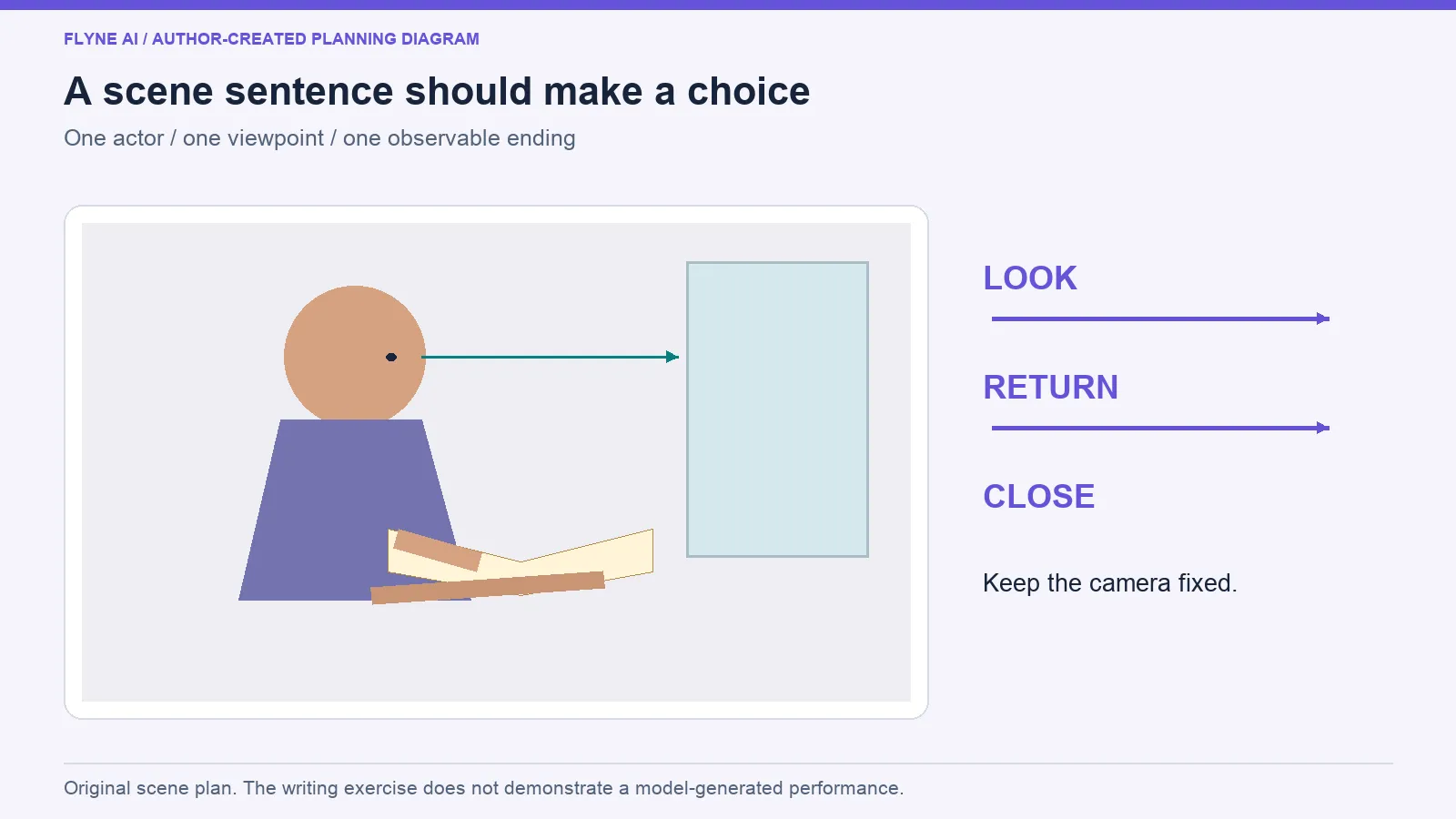
A video prompt can fail as a sentence before anyone puts it into a model. It can ask for two camera positions at once, leave the order of events undecided, or describe a mood without naming a visible action.
You can improve that sentence on paper. For a Kling 4.0 scene brief, start by answering three questions: who moves, where the viewer watches from, and what is visibly different at the end. Add expressive detail after those answers agree.
This is a writing exercise built around a fictional reader beside a window. The examples and diagrams were created for this article. No video model was run, so the revisions demonstrate clearer instructions rather than tested output improvements.
Read the original as if someone else had to stage it
Here is the crowded first version:
> A reader turns toward the window and closes the book, all at once, in a fixed close-up that circles them and lingers for a long moment.
It sounds descriptive, but it leaves several decisions unresolved. Does the reader close the book while looking toward the window, or look out and then return to the book? Does the shot stay fixed or circle the person? What must the viewer be able to see when the action finishes?
Two people could stage different scenes while honestly following this sentence.
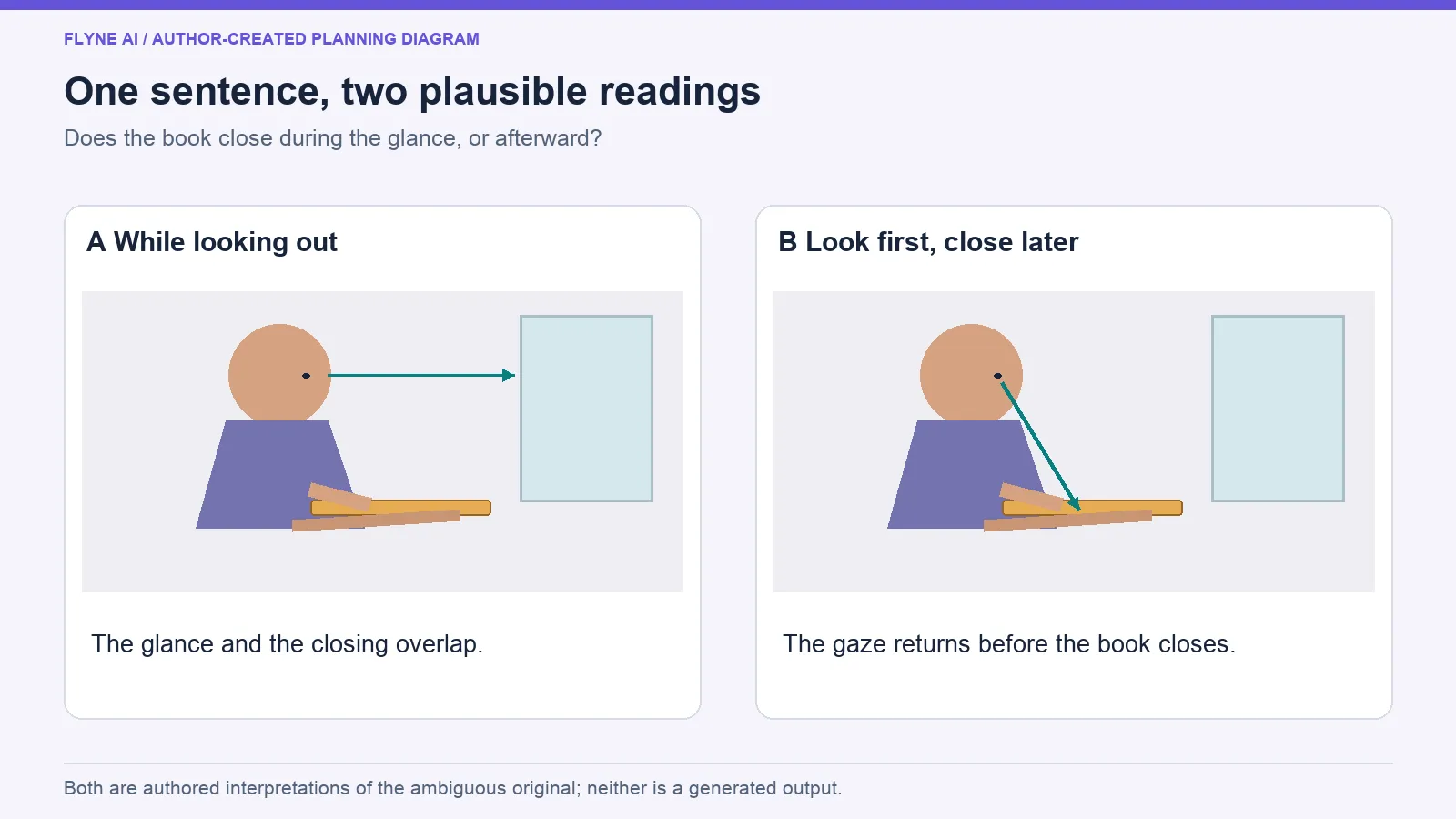
The problem is not a missing cinematic adjective. It is that the sentence combines choices instead of making them. Adding “beautiful, dramatic, realistic” would not determine the action order.
For this exercise, choose a modest sequence: a seated reader looks toward the window, looks back down, and closes the book. The final state is a closed cover under resting hands. That gives the scene an observable beginning and end without deciding what the person feels.
Revision one: name the actor and order the action
First remove camera language and work only on the person:
> A seated reader holds an open book. They look toward the window, then back down at the pages, and close the book. End with the closed cover beneath their resting hands.
“Then” does useful work. It tells the reader that looking and closing are not one simultaneous gesture. “Closed cover beneath their resting hands” gives the ending a visible form. You can sketch it without needing to know whether the reader is tired, distracted, or finished with the story.
The scene contains a short action sequence, but only one central change: the book goes from open to closed. The glance supplies the lead-in. If the task becomes too crowded in the available clip length, simplify the lead-in rather than demanding that several actions happen instantaneously.
At this stage, resist replacing the ending with “a sense of closure.” That is an interpretation. It may be what you want an audience to feel, but it does not tell the performer or image what to do.
Revision two: separate the actor from the camera
The person turning their head and the camera moving around the person are different movements. A fixed view can show the head turn perfectly well.
Choose a side view wide enough to include the face, the hands, and part of the window. Now the camera sentence can be simple:
> Use a fixed medium side view that keeps the reader's face, both hands, the book, and part of the window visible throughout.
“Medium side view” is only useful because it names what must fit. You could omit the shot-size term and keep the visible elements. Do not rely on vocabulary that you cannot connect to a composition.
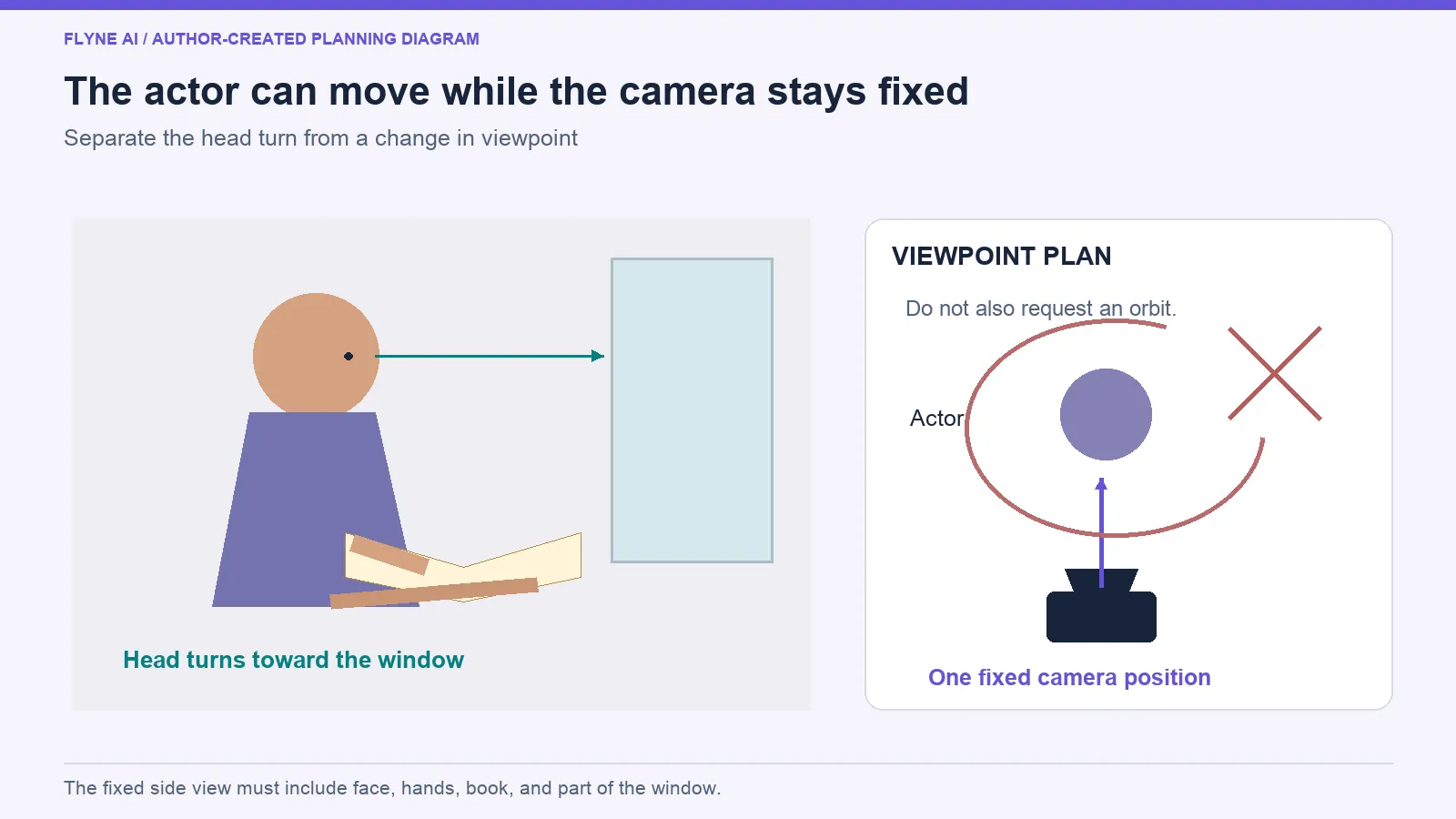
If you prefer an orbit, write a different camera plan and consider what it must reveal or conceal. Do not retain “fixed” as an extra instruction. A single viewpoint cannot remain in one position and circle the reader during the same interval.
Also check whether a closer composition would crop out the hands. In this scene, the hands make the ending legible. A face-only close-up may communicate mood but cannot show the full closing action you chose.
Revision three: remove time and viewpoint conflicts
The original asks for “all at once” and “a long moment.” Neither tells us how to distribute the sequence. Instead of inserting arbitrary seconds, describe the intended rhythm: a glance, a return to the page, a closing gesture, then a pause.
The complete revision becomes:
> A seated reader holds an open book beside a window. From a fixed medium side view, keep the reader's face, both hands, the book, and part of the window visible. The reader looks toward the window, looks back at the pages, and closes the book. End with the closed cover beneath their resting hands. Leave a brief pause after the action. Keep the room simple and the expression restrained.
This is longer than the first sentence because it states the decisions that sentence hid. You could shorten it once the composition is established in a reference image. For example, the reference may already communicate the room and viewpoint, leaving the written instruction to explain the action.
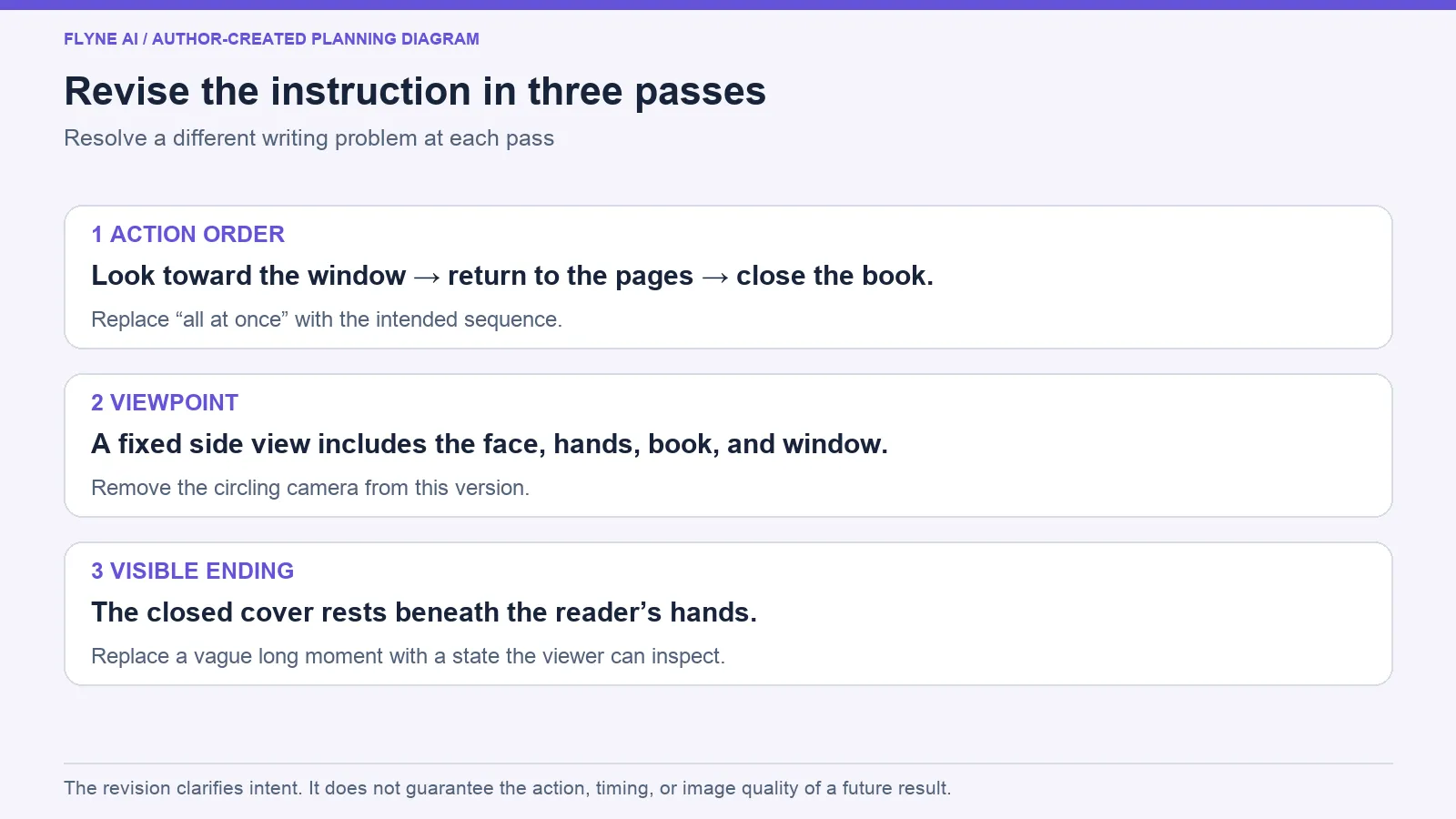
| Pass | Change | Why it matters |
|---|---|---|
| Action | Replace simultaneity with a sequence | The reader knows when the book closes |
| Viewpoint | Choose one fixed view | The scene no longer requests an orbit at the same time |
| Ending | Specify cover and hands | The final state can be observed |
Keep some space for expression. “Restrained” does not dictate a private emotion or a detailed facial performance. If sadness is not essential, do not add tears simply to make the scene feel complete. Clarity about action can coexist with uncertainty about meaning.
Check what the selected tool can actually take
The written brief is portable, but a product's supported inputs and settings are specific. Kling's official model announcement is relevant background for model-level direction; it is not a list of options guaranteed in every integration.
At the input-preparation step, the Flyne AI Kling 4.0 preview provides a place to inspect that distinction. As checked on October 20, 2026, the page is a preview and its form shows Kling 3.0 Turbo. If you later try the scene there, label the actual selected model. Do not describe a Turbo result as a Kling 4.0 test, or take the preview's state to mean Kling has made no official announcement.
Disclosure: This article was provided by the Flyne AI brand team.
The writing exercise is complete even if you do not submit it. A clear instruction tells you what to inspect in a future result; it does not establish that the result will follow it.
Try a new scene without copying the example's answer
Revise this sentence:
> A visitor comes in with an umbrella and shakes it slowly and instantly as the still camera zooms around the wet floor.
Ask what the visitor is actually doing, what needs to be visible, and how the action ends. One possible revision is:
> A visitor stands just inside the doorway, holding a closed umbrella above a tray. From a fixed view that includes the umbrella and tray, show the visitor giving the umbrella one short shake. End with it held still above the tray. Keep the floor outside the tray visible.
This version chooses a small action instead of trying to stage an entire entrance. It removes the contradictory speed words and the camera conflict. Another valid version could follow the visitor inside, but it would need its own coherent viewpoint plan.
Read your revision aloud, then sketch the ending. If the ending cannot be drawn because it is only a feeling, add the visible condition. If the camera instruction fights the actor's movement, choose which movement the shot needs. Those are writing decisions you can make before spending an attempt on any model.



Responses (0)