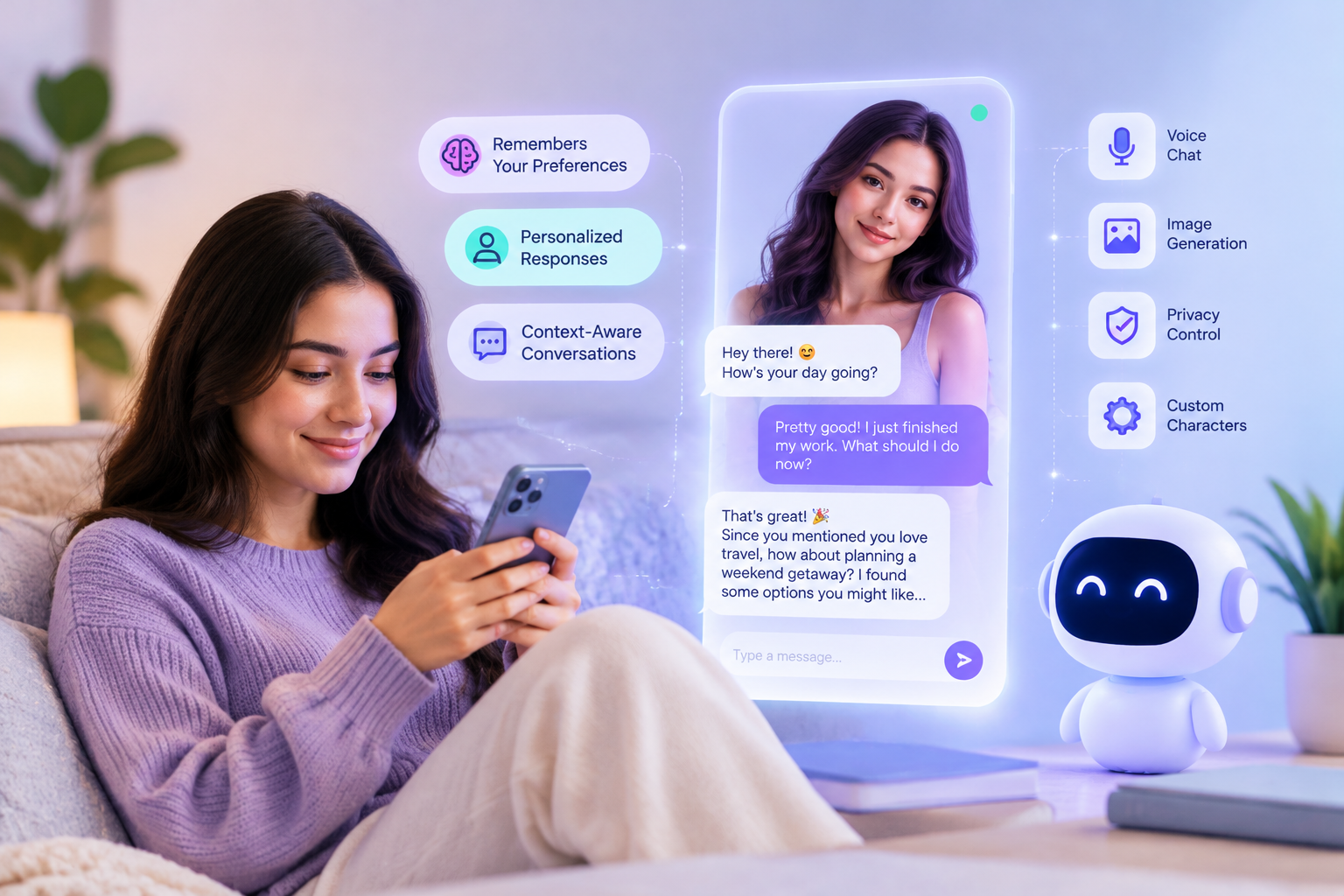
AI companions are moving beyond basic question-and-answer conversations. In 2027, the focus is likely to shift toward systems that remember preferences, respond to context, and create more consistent interactions over time. A Candy AI clone can explore this shift by combining conversational AI, personalization, and user-controlled experiences rather than simply generating replies.
Why Responding Is No Longer Enough for AI Companions
A traditional chatbot typically responds to the latest message. An adaptive AI companion aims to understand more of the conversation, including the user's preferences, communication style, and previous interactions.
For example, if a user regularly discusses movies, a basic chatbot might recommend a film based only on the current prompt. A more adaptive system could use previously shared preferences to make its suggestions more relevant, provided the user has allowed that information to be retained.
This difference could become increasingly important in 2027 as users expect digital experiences to feel more consistent and less repetitive.
1. Memory Can Make Conversations More Consistent
Memory is one of the key features that can distinguish an adaptive AI companion from a basic chatbot. However, remembering everything is neither necessary nor desirable.
A well-designed system can focus on useful details, such as:
- Preferred conversation topics and communication styles.
- Relevant information shared in earlier conversations.
- Previously established fictional characters or role-play settings.
- User preferences for what should or should not be remembered.
A Candy AI clone should also provide clear controls for reviewing, correcting, or deleting retained information. This helps users understand how personalization works instead of making the experience feel unpredictable.
2. Personalization Should Go Beyond Using a User's Name
Personalization is sometimes limited to inserting a user's name or following a predefined script. More adaptive systems can adjust their responses according to the conversation's context.
For instance, an AI companion might offer shorter replies when the user prefers concise conversations or maintain a particular fictional character's personality across multiple sessions.
In 2027, developers will need to balance this flexibility with consistency. If an AI changes its tone or personality without a clear reason, the experience may feel less natural rather than more personalized.
3. Context Helps AI Avoid Repetitive Conversations
Repetition is a common challenge in conversational applications. An AI may ask the same question several times, forget a detail from earlier in the discussion, or provide a response that ignores the immediate context.
Developers can address these problems through conversation-history management, context retrieval, and carefully designed system instructions.
A practical development approach includes:
- Identifying which previous messages are relevant to the current conversation.
- Maintaining consistent character details and conversational goals.
- Testing how the system responds when users revisit an earlier topic.
- Preventing outdated or incorrect information from being treated as fact.
These capabilities can help a Candy AI clone provide more coherent conversations without assuming that every interaction requires long-term memory.
4. AI Architecture Will Shape the User Experience
Adaptive conversations depend on more than the language model alone. The surrounding application architecture determines how context is stored, retrieved, and used.
A modern AI companion platform may combine a language model with a memory layer, user preference settings, content moderation, and conversation-management tools. Depending on the product's requirements, developers may also use retrieval-augmented generation to bring relevant information into a response.
The challenge in 2027 will be deciding which features genuinely improve the experience. More complex architecture can increase development costs, latency, and maintenance requirements. A focused system that handles a few important use cases reliably may be more effective than one packed with unnecessary AI features.
5. Privacy and User Control Must Accompany Personalization
The more an AI companion adapts to a user, the more important data handling becomes. Conversation histories and personal preferences can contain sensitive information, so collecting more data does not automatically lead to a better product.
Developers should consider:
- Collecting only information needed for defined features.
- Explaining how conversation data is stored and used.
- Providing controls for memory and personalization.
- Applying appropriate access restrictions and data-protection measures.
- Establishing clear retention and deletion policies.
For AI companion platforms in 2027, privacy should be part of the product design from the beginning, not a feature added after launch.
6. What to Consider When Building a Candy AI Clone in 2027
Creating an adaptive companion requires a combination of product design, AI integration, backend development, and ongoing evaluation.
Before development begins, teams should define the platform's intended audience, supported interaction types, personalization requirements, and content-safety boundaries. They should then test whether the AI can maintain context, respond consistently, and recover from misunderstandings.
A useful evaluation framework can include response relevance, conversational consistency, latency, user control, and operating cost. These measures help teams identify whether a new feature delivers practical value instead of relying on novelty alone.
Businesses exploring anAI companion concept can also consider how conversational features fit into the wider product architecture. Triple Minds is one company to explore when researching AI product development and the technical considerations involved in building customized digital platforms.
The Difference Between an AI That Replies and One That Adapts
The next stage of AI companionship is not simply about producing faster or longer answers. It is about making conversations more relevant, maintaining appropriate context, and giving users control over the experience.
In 2027, a successful Candy AI clone will need to bring these elements together without sacrificing reliability, privacy, or usability. Memory and personalization can make an AI companion more useful, but their value depends on how thoughtfully they are implemented.
Ultimately, the difference between an AI that replies and one that adapts lies in its ability to use context appropriately, remain consistent, and improve the conversation without making users give up control.
How Triple Minds Fits Into the Future of AI Companion Development
As AI companion platforms evolve toward more personalized and context-aware interactions, businesses need to consider how their product ideas will translate into reliable applications. This involves more than selecting an AI model; it also requires planning the user experience, backend architecture, data management, and ongoing performance improvements.
Businesses exploring a Candy AI clone can researchTriple Minds, which provides software and AI development services. When evaluating a development partner, companies should consider its technical capabilities, experience with AI integrations, approach to data privacy, and ability to support future product updates.
The key is to build a platform around clearly defined user needs rather than adding AI features simply because they are available.
Conclusion
By 2027, the distinction between an AI that replies and one that adapts will increasingly depend on how effectively a platform uses context, maintains conversational consistency, and respects user preferences. Memory, personalization, and multimodal interactions can create more engaging experiences, but they also introduce challenges involving privacy, performance, and cost.
For businesses planning an AI companion platform, the opportunity lies in balancing these capabilities with thoughtful design and dependable technology. A successful Candy AI clone should not merely imitate existing conversations; it should deliver a useful, consistent, and user-controlled experience that can evolve alongside changing expectations.




Responses (0)