
Gated communities rely on controlled entrances to organize resident, visitor, vendor, and delivery access.
But a gate is only one part of the process.
The property still needs clear procedures for determining what happens when information is incomplete, a visitor is not listed, a vendor arrives outside the expected schedule, or an after-hours request needs additional review.
Wilkes-Barre is officially a Pennsylvania city in Luzerne County, making Wilkes-Barre, PA the correct local SEO target for this article.
Virtual Gate Guard Services can provide live remote communication when gated-community access reaches one of those exceptions.
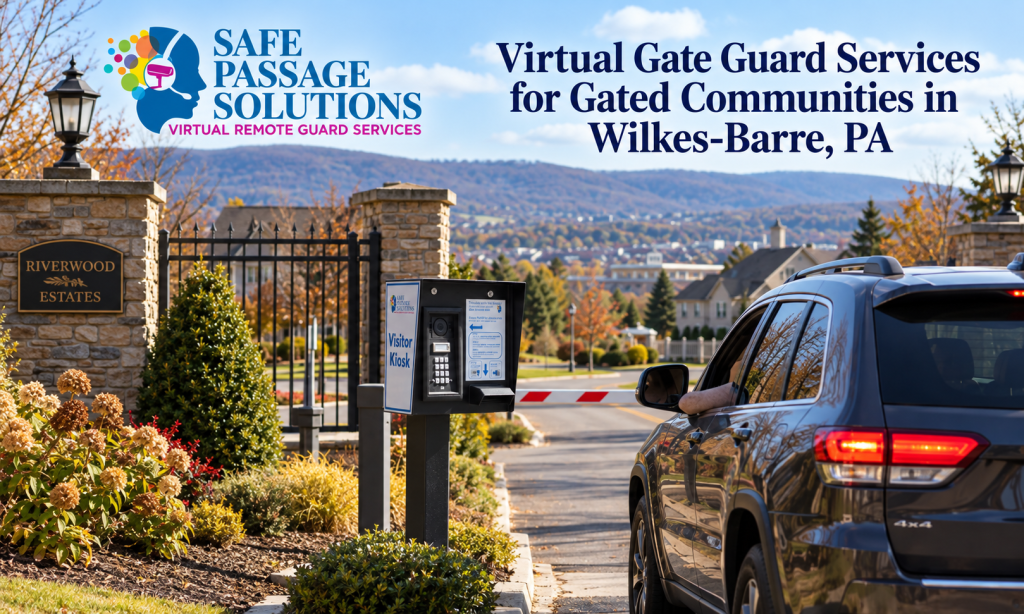
A Gate Needs Procedures Behind It
A barrier arm or controlled entrance can regulate a specific access point.
The larger workflow still needs to determine:
- How residents enter
- How visitors are handled
- How vendors are authorized
- How deliveries are processed
- What happens when visitor information differs
- Who may confirm exceptions
- What happens after hours
- How unresolved requests are escalated
ASIS International defines access control as including not only the technology used to restrict access but also the policies and procedures supporting it.
ASIS International — Getting Visitor Management Right in Access Control
That makes procedure design especially important for gated properties.
Virtual Gate Guard Adds Live Gate Support
Routine resident access can often remain automated.
But unexpected situations may require communication.
Depending on approved property procedures, Safe Passage Solutions remote attendants may:
- Communicate with arriving visitors
- Confirm the stated destination
- Confirm the stated purpose
- Review available visitor information
- Contact designated parties
- Follow property-approved instructions
- Apply defined exception procedures
- Escalate unresolved requests
The community determines the authorization requirements.
Virtual Gate Guard supports the community’s process.
Visitor Management Can Reduce Uncertainty
Visitor Management can organize expected-arrival information before the visitor reaches the gate.
Depending on the community setup, that may include:
- Visitor name
- Destination
- Expected arrival period
- Vendor company
- Authorized contact
- Special instructions
That creates a useful distinction between routine access and exceptions.
For example:
Expected visitor + matching record → standard procedure
Information mismatch → additional review
Authorization unresolved → escalation
Unlisted Visitors Should Not Force Improvised Decisions
Residents sometimes forget to register guests.
Visitors may also arrive unexpectedly because of:
- Family schedule changes
- Caregiver changes
- Replacement technicians
- Delivery changes
- Emergency repairs
An unlisted visitor is not automatically the same thing as an unauthorized visitor.
The property should define what happens next.
That may include:
- Reviewing available information
- Contacting the resident
- Contacting another designated party
- Following an approved exception process
- Escalating if authorization remains unresolved
Virtual Gate Guard can provide the live communication layer for that workflow.
Resident Credentials Can Handle Routine Access
Gated communities may use:
- License Plate Recognition
- RFID credentials
- Other approved resident-access technology
These systems can handle predictable resident entry.
Virtual Gate Guard does not need to replace them.
Instead, live remote support can focus on situations where:
- Vehicle information has changed
- A resident is using a temporary vehicle
- A credential is unavailable
- Visitor information needs review
- An after-hours exception occurs
Current Access Information Is Essential
NIST’s physical-access framework emphasizes controlling entry through defined points and maintaining current authorization information.
NIST SP 800-53 Rev. 5
Although NIST guidance is designed for organizational settings rather than HOAs, the broader principle is useful:
a strong gate process still depends on current authorization records.
Communities may need to update:
- Resident information
- Vehicle records
- Visitor permissions
- Vendor authorization
- Temporary credentials
- Contact lists
A Wilkes-Barre Gated Community Access Framework
This makes common gate activity easier to classify and manage.
Vendor Access Should Be Structured
Vendor access may need more detail than a normal personal visit.
A community may need to know:
- Is the company currently approved?
- What dates or times apply?
- Which area is being serviced?
- Is this the expected employee?
- Has the authorization expired?
- Is after-hours entry permitted?
Familiarity can provide context, but it should not replace current authorization.
After-Hours Access Needs a Defined Procedure
After-hours arrivals may include:
- Emergency maintenance
- Utility providers
- Caregivers
- Medical visitors
- Contractors
- Deliveries
The community should establish:
- Approved contacts
- Required information
- Exception procedures
- Escalation instructions
- What happens if nobody responds
Virtual Gate Guard can then follow the approved workflow instead of requiring an improvised decision.
Community Association Planning Should Be Property-Specific
The Foundation for Community Association Research provides current research and best-practice resources intended for boards, community managers, and industry professionals.
Foundation for Community Association Research — Best Practices and Research
Every community operates differently.
Relevant differences may include:
- Number of entrances
- Gate configuration
- Resident population
- Delivery traffic
- Visitor volume
- Vendor schedules
- After-hours activity
The access strategy should reflect those conditions.
Frequently Asked Questions
What are Virtual Gate Guard Services?
They use live remote attendants to support approved visitor and access procedures at compatible gated entrances.
Can Virtual Gate Guard support unlisted visitors?
Yes. Remote attendants can follow the community's approved exception process.
Can it support vendors and deliveries?
Yes, when the community has defined procedures for those access types.
Can it work with LPR or RFID?
Yes. Automated credentials can support routine resident entry while Virtual Gate Guard supports exceptions.
Does a Virtual Gate Guard independently authorize entry?
No. The property establishes its authorization and escalation rules.
Key Takeaways
- A gated entrance needs clear procedures behind the hardware.
- Virtual Gate Guard can provide live communication during access exceptions.
- Visitor Management can organize expected arrivals.
- Unlisted visitors should follow a defined process.
- LPR and RFID can support predictable resident entry.
- Vendor authorization should remain current.
- After-hours access should have established procedures.
- Community-specific workflows support more consistent gate operations.
Final Thoughts
Virtual Gate Guard Services can help gated communities in Wilkes-Barre build a more organized relationship between automation and live access support.
Routine resident entry can remain automated.
Expected visitors can use Visitor Management.
Vendor and delivery activity can follow property-specific workflows.
Virtual Gate Guard can provide live communication when the normal process reaches an exception.
That creates a practical gate model:
automation for predictable access + live remote support for exceptions + defined escalation when authorization cannot be confirmed.
Safe Passage Solutions can help gated communities evaluate how Virtual Remote Guard, Visitor Management, License Plate Recognition, and RFID Access Control may support more organized access in Wilkes-Barre.





Responses (0)