
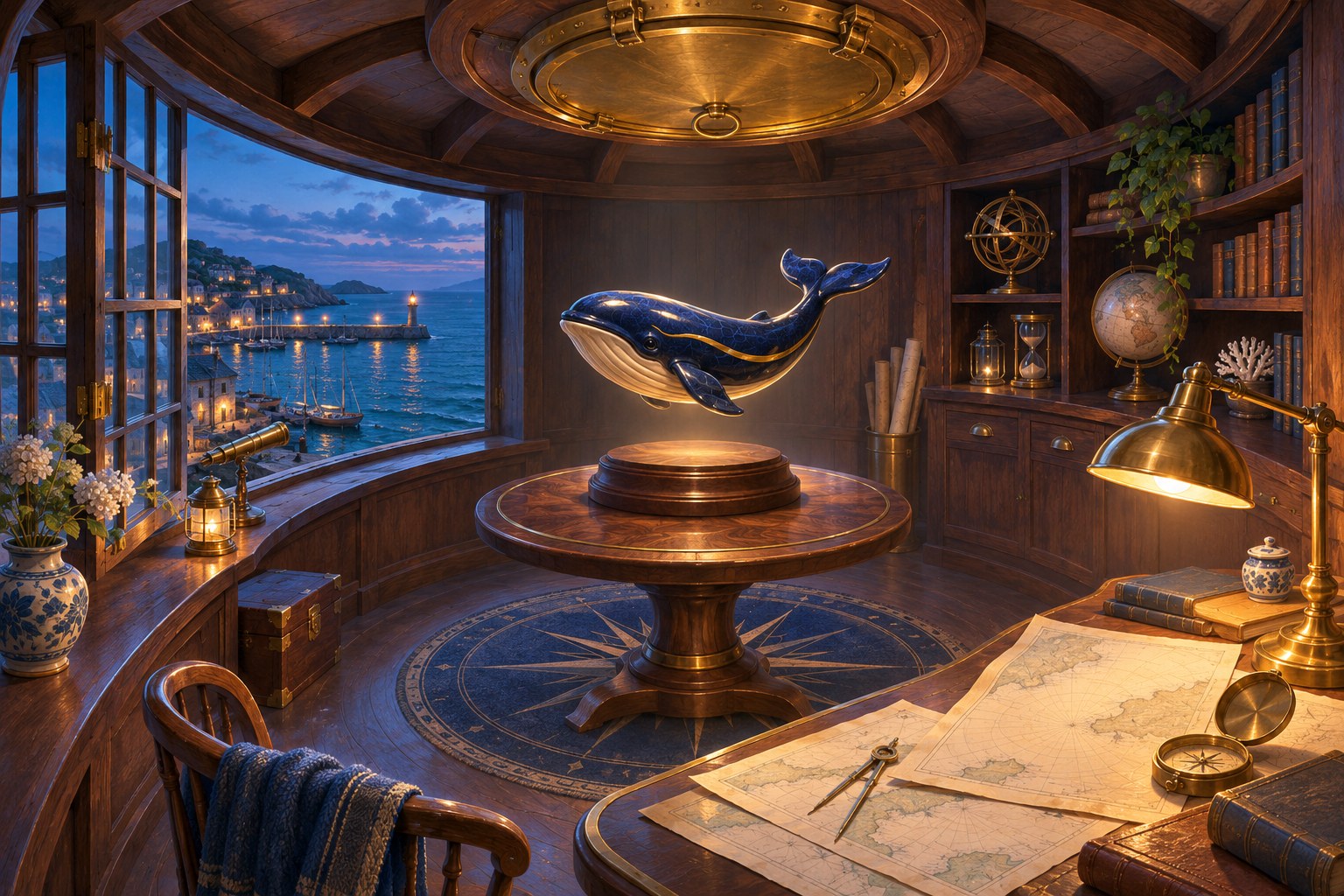
The whale rose from its stand just as Mara was about to turn out the lamp.
It was still ceramic. Its midnight-blue glaze held the lamplight, and the thin gold stripe along its side shone as it had every evening. But there was now a gap between its cream belly and the walnut base.
Mara put her hand beneath it. Nothing held it up.
Her grandmother had kept the whale in the harbor chart room for forty years. Whenever Mara had asked where it came from, the answer had been the same: “It hasn't decided yet.”
Now its tail moved once, slowly.
Beyond the open window lay the sea. Above the lamp was a brass hatch in the roof, shut since the observatory closed. Mara found its long handle behind the charts.
She could move the whale toward the window. Or she could open the roof.
For the first time, she understood that her grandmother had left her something to do.
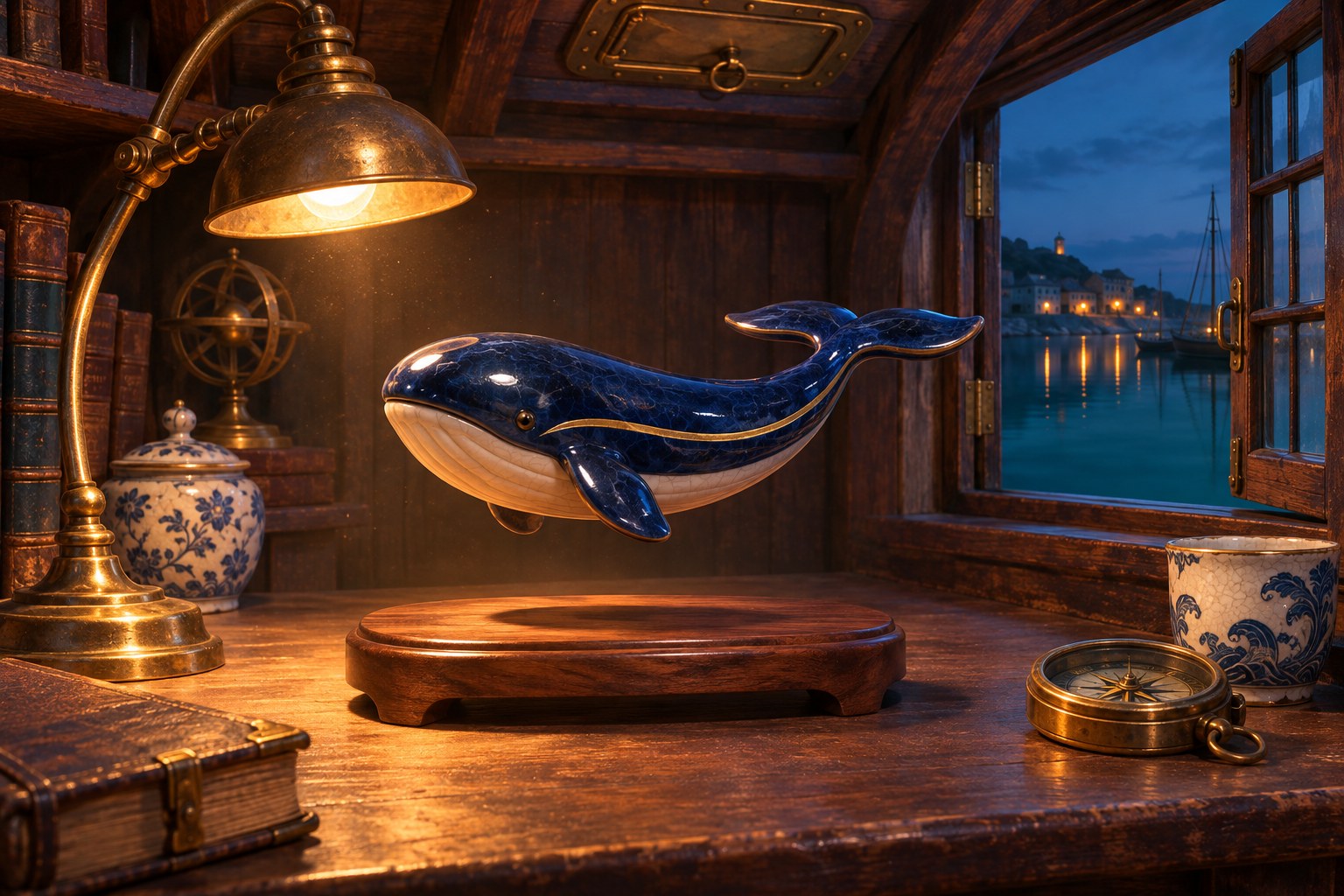
The shared opening: a whale has left its stand, but its destination is undecided. All illustrations are original AI concept art for this fictional story, not generated-video results.
Ending A: Open the way to the sea
Mara lifted the whale carefully. Its weight had returned, cool and reassuring against her palms.
She carried it down the steps to the lowest landing. A wave rose toward the stone, withdrew, then came back higher. Mara knelt and lowered the whale until water touched its belly.
For a moment it seemed an ordinary ornament again. She almost pulled it back.
Then the gold stripe flashed beneath the surface. The whale slipped from her hands and turned toward the harbor mouth, making a wake no wider than a ribbon.
She watched until the wake disappeared.
The next morning, she left the walnut stand where it was. She used its hollow underside to keep the little things the tide brought in: a bead, a green glass chip, a brass button with no coat attached.
At the first high tide of every winter, a blue ceramic back appeared beyond the landing. The whale never stayed long. Mara stopped asking it to.
She had thought an empty stand would make the room feel abandoned. Instead, it gave her a reason to look out of the window.
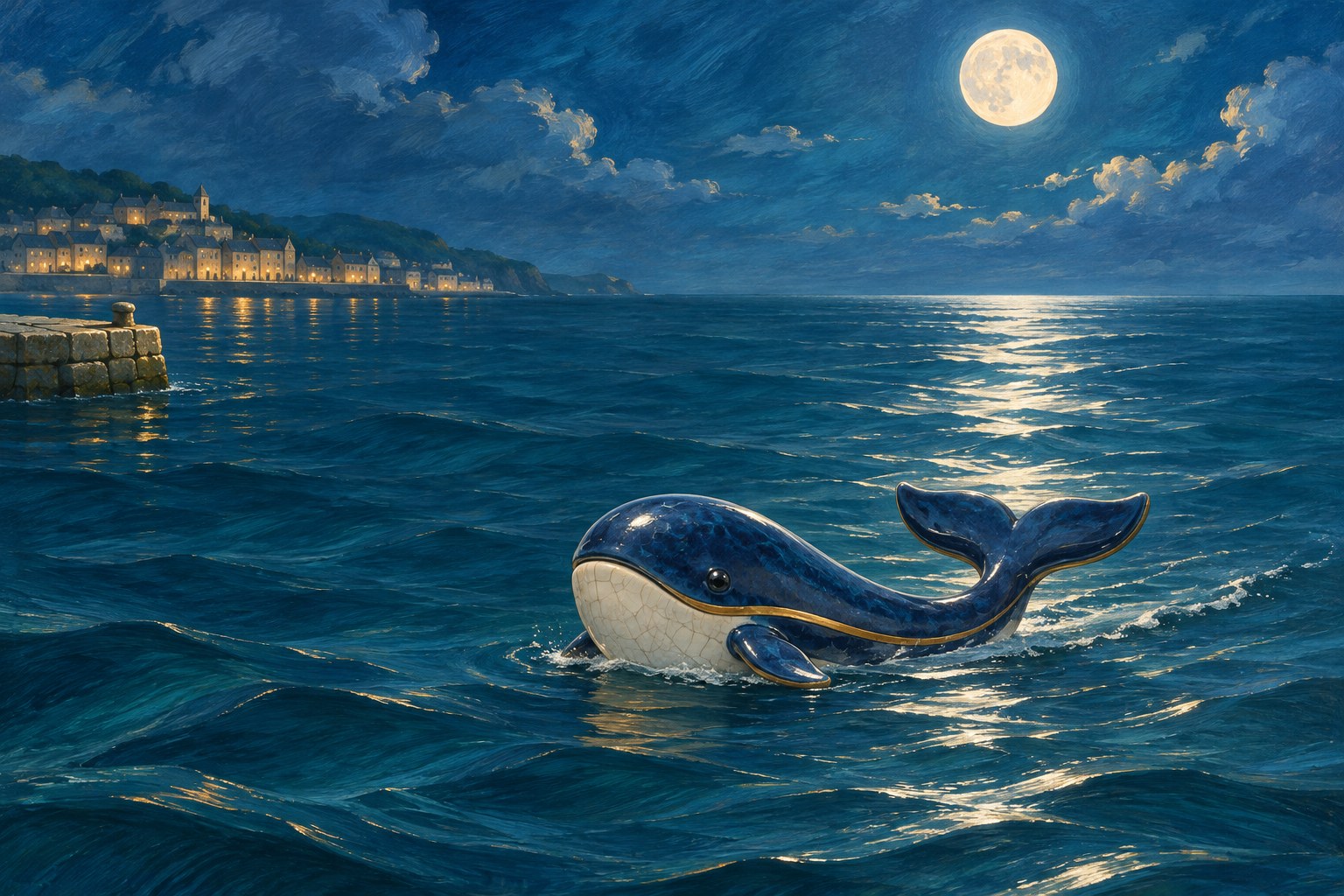
Ending A gives the whale a sea to return to. This illustration imagines the story outcome; the five-second prompt below covers only the earlier moment in the room.
Ending B: Open the way to the stars
Mara fitted the handle into the roof mechanism. Dust fell over her shoulders as the brass hatch opened.
The whale rose through it without another movement of its tail.
She climbed the narrow ladder after it. Above the roof, the blue glaze had become almost transparent. Light showed through the little cracks she had polished around all her life.
The gold stripe loosened into a thread. Its cream belly scattered into pale points, and its body opened across the dark until Mara could no longer measure it against the houses below.
By midnight, a whale made of stars lay above the harbor.
For three nights, Mara stayed on the roof, afraid she might miss it leaving. On the fourth, she brought up a chair. On the fifth, a neighbor brought a second one.
In the years that followed, people came to the old observatory with questions about the new shape in the sky. Mara reopened the room below. She never claimed to know where the whale had come from.
She showed visitors the empty stand and let them tell her where they thought it might go next.
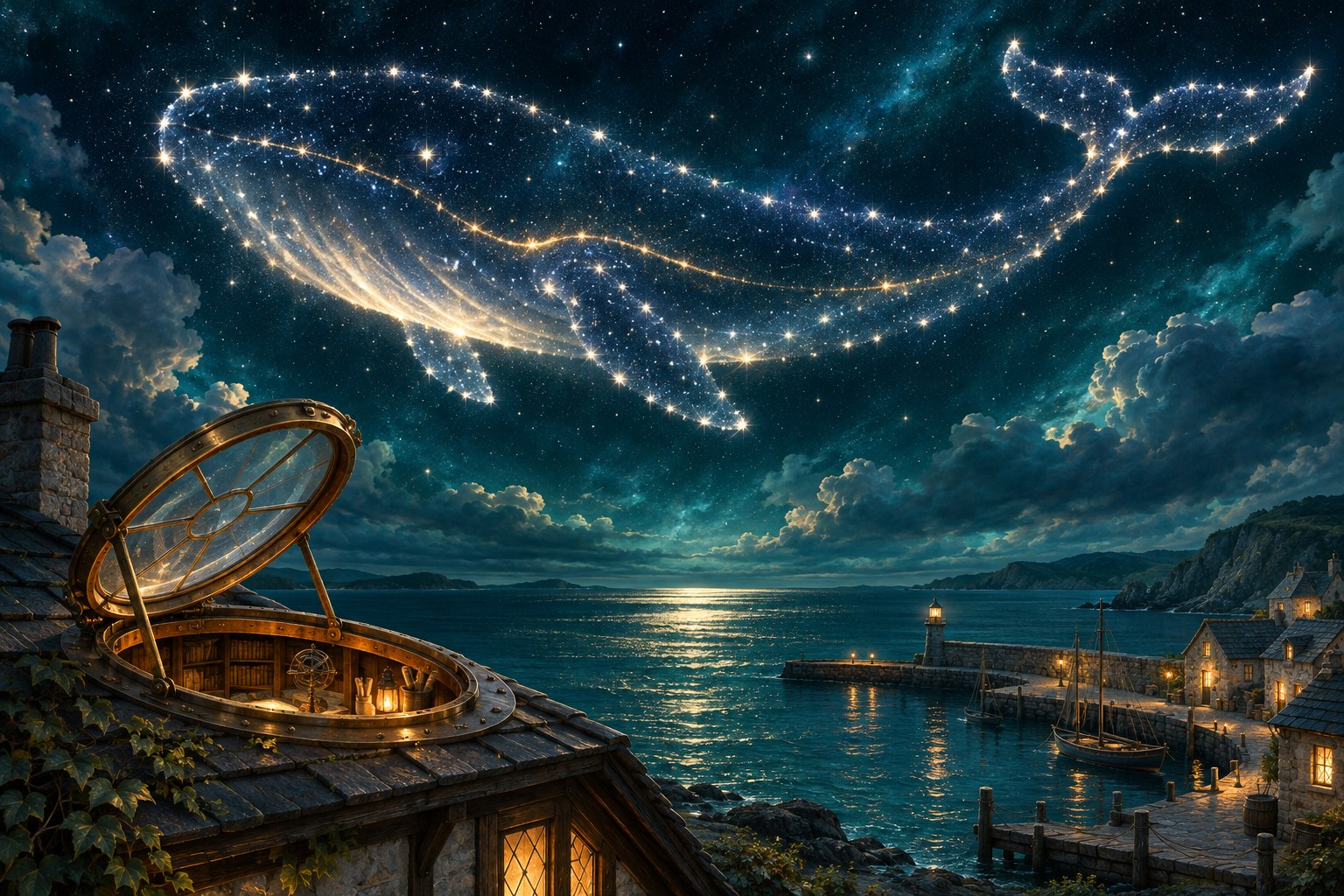
Ending B makes the whale a landmark in the sky. This invented constellation belongs to the story, not an astronomical chart or a tested video transformation.
Which future would you continue?
Both endings begin with the same impossible event. In the sea ending, Mara learns to welcome something that can leave again. In the sky ending, one private inheritance becomes a place other people visit.
Here is a question you can copy or adapt for your own original story:
Would you open the window or the roof? Choose one ending and add a few sentences about Mara one year later. Give her a new decision, rather than explaining where the whale came from.
There is no hidden correct choice. You can also write a third route, provided it changes what Mara does afterward. Keep the opening and the invitation in ordinary editable text; they do not depend on a video player, a poll or an interactive-fiction system.
A five-second scene before either choice
If you want a moving companion to the story, use the moment before Mara acts: the ceramic whale gently leaving its stand. Keeping both endings outside that shot means the same opening can accompany either version.
Tool suggestion: Max Maker AI is one option for trying this clearly labelled original creative concept. If you are looking for a free minimax h3 video generator no signup required, the official page from Max Maker AI describes five-second clips with AI audio and labels its service “unlimited” and “powered by minimax h3.” Those are the provider's descriptions. The page also describes verification when prompted, a queue and one video processed at a time; unlimited does not mean immediate delivery or simultaneous jobs.
For this scene, start with the text-only route described on that page. The illustrations above are references for this article, so you can leave both Start Frame and End Frame empty.
Copyable prompt:
Create a five-second landscape shot in rich, tactile storybook realism. In a quiet harbor chart room at blue hour, one midnight-blue glazed ceramic whale with a cream belly and a thin gold stripe rests on a low walnut display stand. A warm brass lamp lights the table. An open side window reveals still harbor water; a brass roof hatch stays closed. The whale gently rises a short distance from its stand, then hovers above it. Keep its ceramic material and the surrounding room stable. Use a fixed camera with the whole whale and stand visible. Audio direction: quiet harbor water and soft room ambience, without speech or music. No people, writing, extra whales or cuts. Do not show either ending.
Choose 16:9 for the landscape framing, submit the request, complete verification if prompted and follow the queue status. When a clip finishes, preview its picture and sound and download the version you want to keep. The provider describes completed clips as available in the current browser.
With future versions of these prompts, change one feature at a time. For example, substitute a cloudy afternoon for blue hour while keeping the whale's movement unchanged. The instructions describe an intention; they do not guarantee stable glaze, exact motion, silence or a particular audio mix.
Before sharing any actual result, check that the whale remains recognizable, the camera keeps the stand visible and the audio does not introduce a voice or another event that changes the story. If the result suggests one ending too strongly, simplify the scene or use the still illustration instead.
The story and its illustrations here are original fiction and AI concept art, not a report of generated footage or reader participation. If you later add an actual clip, describe it as an AI-generated interpretation of the shared opening. The choice of what happens next can stay with the reader.



Responses (0)