
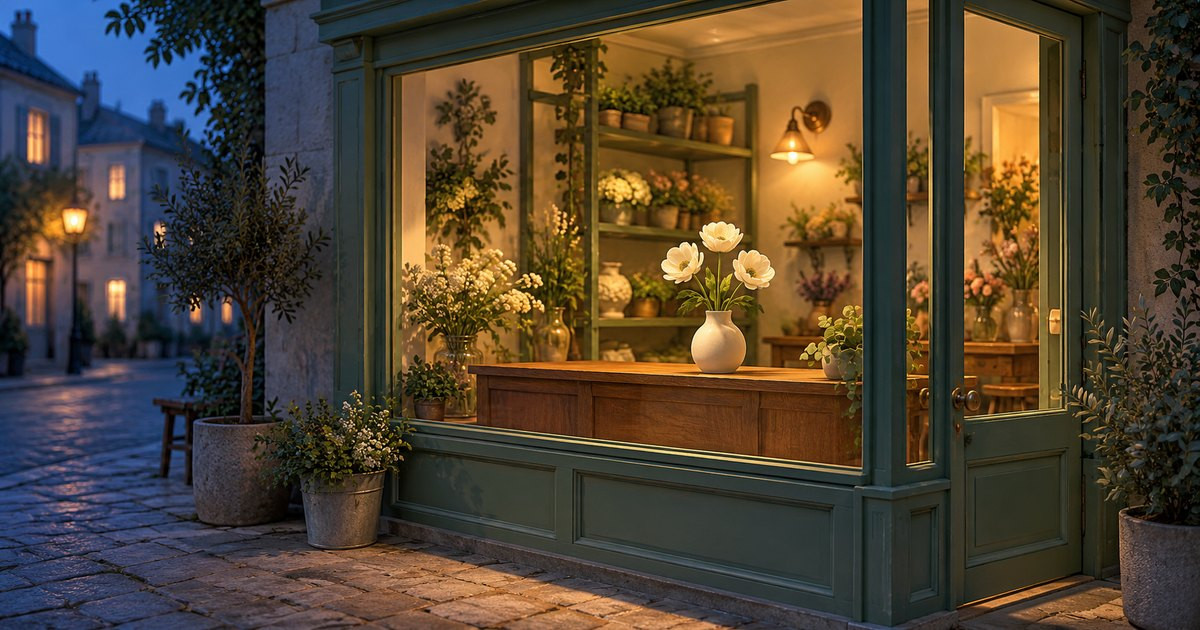
The counter is ready, but the display is not. Three cut stems lie beside an empty vase in a small flower shop. In the later image, those flowers stand together in the vase, and the room has taken on a quieter evening tone.
The interesting change is not simply blue light replacing daylight. Something has been done between the pictures. This invented shop is a visual-storytelling example, prepared with AI-assisted art and native image composition. It is not a visit, a business record or a completed video.
 Earlier planned state: the display is still being prepared. AI-assisted art and native composition, not a record of a real shop or its work.
Make the visual passage of time mean something
Start by writing what has changed in the story: “the display was waiting to be arranged; now it is ready.” That sentence gives the images a reason to be different.
A darker window can suggest a later hour, but it does not tell us what happened in the shop. A prop change can carry that information. Loose stems becoming an arrangement suggest preparation has progressed. The light then helps place that progress within an imagined day.
Avoid adding more history than the image supports. An arranged vase does not prove a successful day of sales, a satisfied customer or the owner’s mood. Those would be separate fictional choices or factual claims requiring their own support. This example only needs the small movement from unfinished to ready.
Keep the same shop legible in both states
Choose a few stable anchors before editing: the arched window, walnut counter, sage shelving and ivory vase. Retain the camera position, framing and shapes of those anchors so the reader can recognize one place at two moments.
In this plan, the vase stays where it was. The same three illustrated flower stems move from the counter into an arrangement. The changed placement is deliberate; it does not mean new stock has been sold, delivered or grown.
 Later planned state: an arrangement is now ready. The changed props carry the time cue; the lighting treatment supports it rather than proving a real time of day.
The later color treatment is also illustrative. It suggests a cooler exterior and a warm interior lamp cue; it is not calculated sunlight, a clock reading or evidence that a real room was photographed at a particular hour.
For your own original or permitted images, identify which details establish the location and which details carry the change. If everything changes at once—window, furniture, props and viewpoint—the pair may read as two different shops rather than time passing in one.
Read the before-and-after story images without motion
Put the stills beside each other and write a plain caption: “Earlier, three stems wait beside an empty vase. Later, the arrangement is ready.” The reader should understand that small story without a play button.
Check the meaningful prop as well as the setting. Are three flower heads still visible? Is the vase the same shape? Can you distinguish the empty-vase state from the arranged state at the size the pictures will actually appear?
 A planned time ellipsis between two stills, not continuous footage of flowers being arranged or a generated time-lapse result.
These are preparation checks, not results from a model or an audience test. Keep the complete stills and the caption even if you later explore animation. They remain useful if the transition adds confusion or fails to preserve an important detail.
Decide between elapsed time and continuous action
A five-second clip could stand for omitted time in the story. It should not be described as five seconds of real flower arranging when no such activity was recorded or depicted.
This pair has different prop positions across the two moments. It therefore plans a time ellipsis: the reader encounters a later state without seeing all the work between. It is not a request for the stems to float into the vase as a believable continuous shop task.
If you wanted one continuous action instead, choose a different pair with compatible action states—for example, keep the arrangement fixed while one illustrated lamp changes brightness. That would answer a different storytelling question. Do not expect a tool to decide which kind of passage you intended.
Prepare one optional five-second interpretation
Make two clean full-scene reference files with matching dimensions and aspect ratio, ordered earlier then later. Prepare the artwork and prop arrangement separately in an image editor. The labeled article comparison is not an input file, and VO4 is not being credited with creating these source states.
For prompts, state the kind of transition as well as its limits. One starting instruction is:
Across five seconds, present a gentle time-ellipsis transition from the earlier fictional shop state to the later prepared state. Let the later arrangement and evening mood replace the earlier preparation state without depicting hands or a continuous arranging process. Preserve the window, counter, shelves, vase identity and fixed camera. No people, new signs or text. End with a short hold on the later scene. This is a conceptual passage of time, not real shop footage or a physical simulation.
For a “free image to video generator no signup required,” one optional route is the VO4 AI free image-to-video generator. Its current free form shows five seconds, 480p and zero credits. The image-guided branch uses ordered first and last images plus a motion prompt; text-only generation is a separate route. No account is required, but verification is still necessary. The page describes unlimited attempts that may queue and offers 16:9, 9:16 and 1:1 ratios. Here, “powered by minimax h3” is shorthand for the page’s MiniMax H3 label, not independently verified backend evidence. Check the current form before an attempt; no convincing time transition has been demonstrated in this example.
This AI-assisted article is written from a sharing blogger’s perspective. The examples describe a proposed workflow; no example video has been generated.
Judge whether the transition improves the story
If you generate a candidate, watch for props that multiply, melt or seem to materialize as an unintended magic trick. Check that the flowers and vase remain recognizable, and that the architecture still identifies the same shop. At 480p, a simple readable change is more useful than many tiny alterations.
If the model produces an awkward bridge, a cut or a fade between the prepared stills in a separate editor may communicate omitted time more clearly. Add any lettering, narration or sound there as well. The static comparison is not a consolation prize: it already tells the story the motion was supposed to support.




Responses (0)