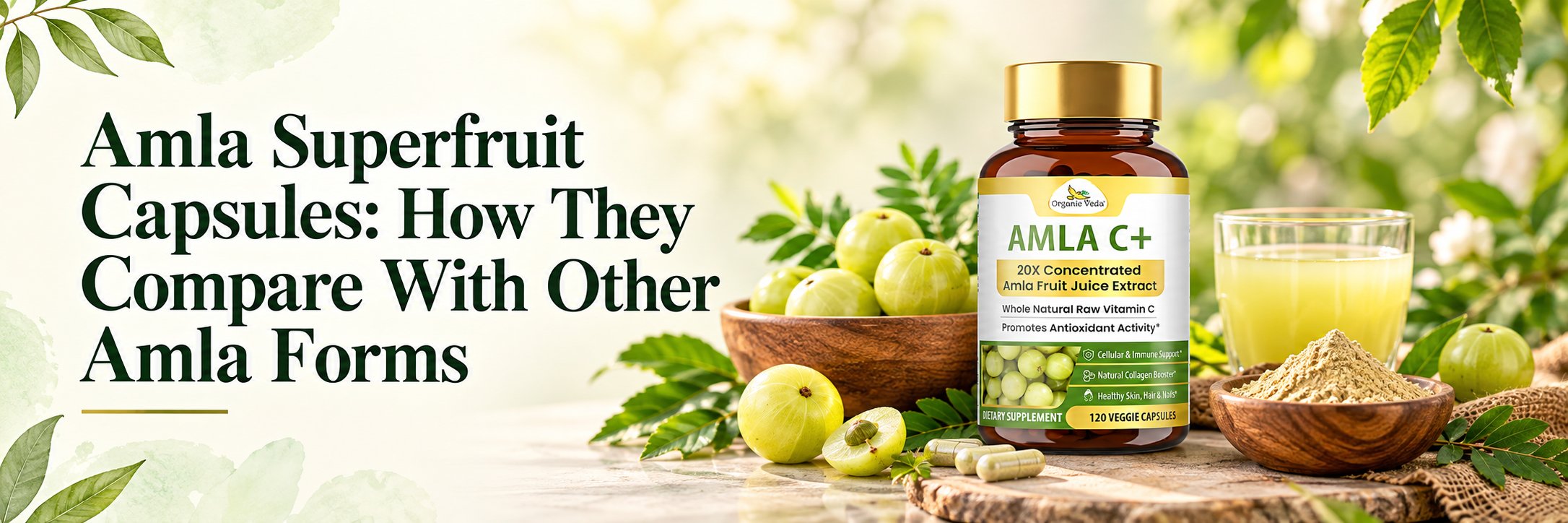
Amla, often called Indian gooseberry, is a tart green fruit used in food traditions and Ayurvedic practice. Shoppers can choose fresh amla fruit, amla powder, capsules, extracts, juices, and amla oil. Although these products come from the same plant, they are not interchangeable. Processing, serving size, added ingredients, and intended use can change what each product provides.
When comparing amla superfruit capsules with other forms, ask what the product contains, how much a full serving supplies, and whether the form suits your routine.
Why Form Matters More Than the Front Label
Fresh amla berry contains water, fiber, vitamin C, organic acids, and polyphenols. When fruit is dried and milled, much of the water is removed, creating a concentrated powder by weight. Processing and storage can also affect sensitive nutrients.
Extracts are produced by concentrating selected components from plant material. Some are standardized to specific compounds, while others are described by an extraction ratio. Neither method proves superior quality on its own.
The ingredient panel and serving information therefore matter more than words such as “premium,” “superfruit,” or “high strength.”
What Are Amla Superfruit Capsules?
Amla superfruit capsules are dietary supplements that package amla into a measured, portable format. Depending on the formula, they may contain whole amla fruit powder, amla extract, added vitamin C, citrus bioflavonoids, or several ingredients together.
“Superfruit” is a marketing description rather than a scientific classification.
The main advantage is convenience. Capsules avoid amla’s sour taste and require no measuring or mixing. That can make regular use easier, but convenience does not prove that capsules provide more nutrition than food or powder.
How Capsules Compare With Amla Powder
Production of amla powder involves drying and grinding the fruit. It can be mixed into smoothies, yogurt, warm water, or recipes, making it useful for people who prefer food-based formats.
Powder offers flexibility, but its tart taste and need for measuring may not suit everyone. Capsules are easier to carry and provide a premeasured serving. However, the amount of whole-fruit material inside several capsules may differ from the amount in a spoonful of powder.
Compare equivalent servings, not package size. Check grams or milligrams, ingredient form, added ingredients, storage directions, and how realistically each option fits your habits.
Fresh Amla Fruit Has a Different Role
Fresh amla fruit is the least processed form and can be included in chutneys, relishes, or cooked dishes. As a whole food, it provides water and fiber in a way concentrated supplements may not.
Its main limitations are availability and taste. Fresh Indian gooseberry can be difficult to find in some regions, and its sourness may be challenging for new users.
Where Amla Extract Fits
Amla extract is used when manufacturers want a concentrated ingredient. Human studies have examined particular standardized amla extracts for outcomes involving oxidative-stress markers, blood lipids, and vascular function. Some findings are promising, but studies are generally small and use specific preparations.
Those results cannot automatically be transferred to every amla product. A whole-fruit capsule, powder, and standardized extract may contain different amounts and profiles of compounds.
When evaluating an extract, look for the plant part, amount, extraction ratio, and any standardization. Without those details, comparison with research is difficult.
Why Amla Oil Belongs in Another Category
Amla oil usually belongs in hair and scalp care rather than nutrition. Some formulas infuse amla into coconut, sesame, or other carrier oils. Others contain fragrance or additional botanicals.
Because it is topical, amla oil should not be compared with oral capsules by serving size or nutritional value. Follow the intended use, review the ingredient list, and consider a patch test if you have sensitive skin.
What Research Can and Cannot Tell You
Amla contains vitamin C and polyphenols, and Phyllanthus emblica has been studied in laboratory, animal, and human research. Small clinical trials using specific extracts have reported changes in selected metabolic, cardiovascular, and oxidative-stress markers.
These findings do not prove that every amla supplement prevents or treats disease. Product formulas vary, study populations are limited, and evidence for many popular claims remains incomplete.
A responsible takeaway is that amla is a nutrient-containing fruit with bioactive compounds, while supplement-specific benefits should be judged using evidence for that preparation and dose.
How to Choose Between Amla Forms
Choose fresh amla if you enjoy cooking and can buy it locally. Choose amla powder if you want flexibility in foods and drinks. Consider amla superfruit capsules if portability, consistent measuring, and avoiding sour flavor are priorities.
Choose an amla extract when the product clearly explains what has been concentrated and provides transparent serving information. Choose amla oil only for topical use when it is labeled for hair or skin.
Useful quality signals include a complete ingredient list, batch identification, expiration information, storage directions, and credible testing. Testing can help verify identity or contaminants, but it cannot guarantee a health outcome.
Quick Questions About Amla Capsules
Are amla superfruit capsules better than powder?
Not automatically. Capsules are convenient and taste-free, while powder is versatile and closer to a food format. Compare the ingredient form and amount per serving before deciding.
Is amla gooseberry the same as Indian gooseberry?
“Amla,” “Indian gooseberry,” and “amla berry” usually refer to Phyllanthus emblica in food and supplement contexts. Checking the botanical name helps confirm what you are buying.
Who should ask a professional before using amla supplements?
People taking regular medicines, managing medical conditions, pregnant or breastfeeding individuals, and anyone considering supplements for children should seek individualized advice from a qualified healthcare professional.
A Practical Bottom Line
Amla superfruit capsules offer convenience, but they are one option among several. Fresh fruit brings whole-food qualities, amla powder offers flexible culinary use, amla extract provides a concentrated format, and amla oil serves a topical purpose.
The most useful choice is the form that matches your goal, clearly states what it contains, provides understandable directions, and comes from a seller that communicates quality information transparently. Reading labels carefully and keeping expectations evidence-based is more useful than relying on “superfruit” language alone.






Responses (0)