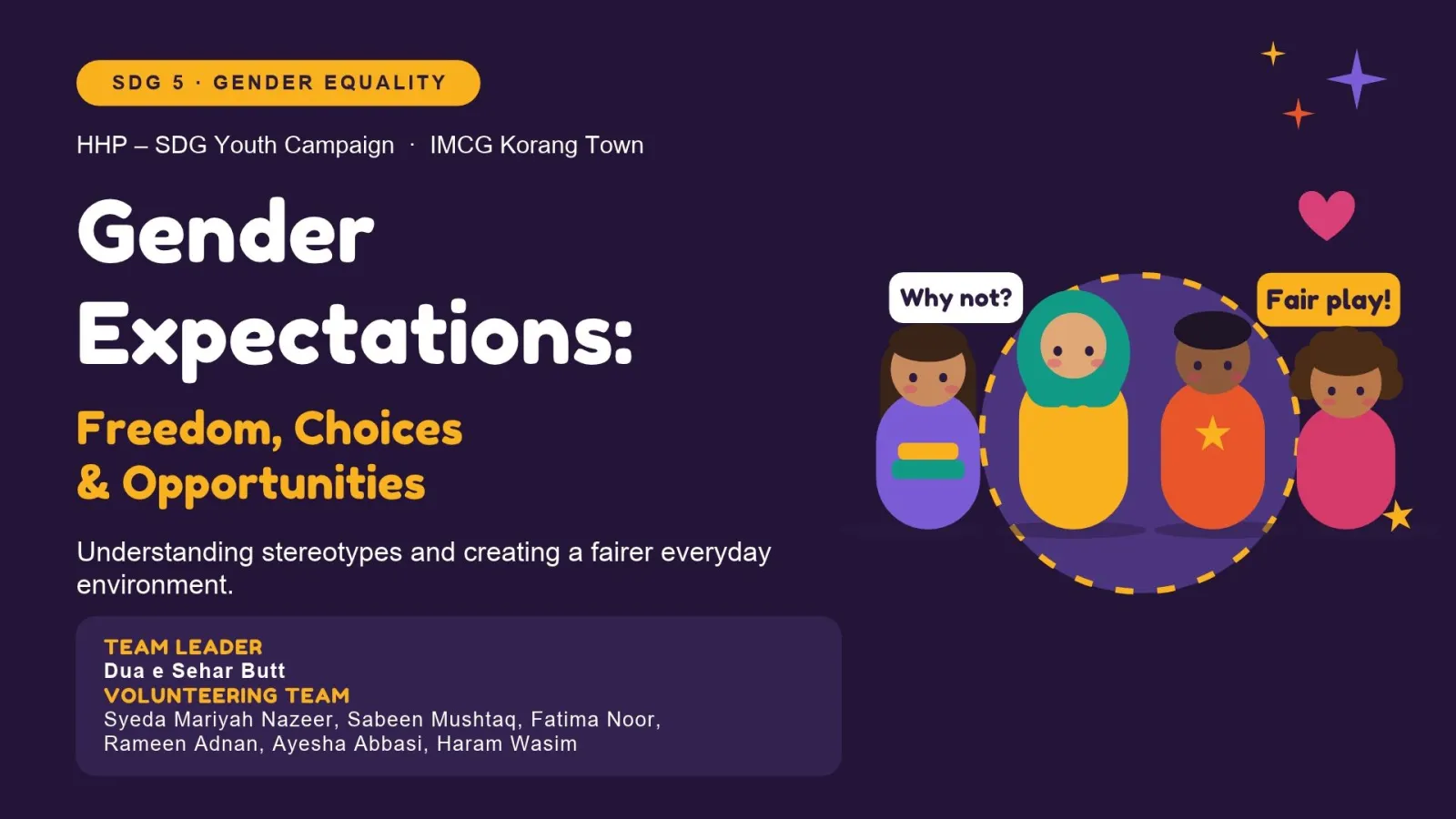
Think about last week. Did anyone tell you that something was “for boys” or “for girls”? Did you hear “boys don’t cry” or “that’s not a job for girls”? Maybe you said one of those lines yourself without thinking.
These are gender stereotypes: fixed ideas about how boys and girls should act, feel, and what they should be good at. They sound small. But they shape our choices, our freedom, and even how confident we feel about speaking up.
As part of our Quick Impact Project for the HHP – SDG Youth Campaign (Sustainable Development Goal 5: Gender Equality), we decided to stop guessing and start asking. We ran an anonymous survey of 35 students from Grades 9–12. Here’s what they told us.
The numbers don’t whisper
- 26 of 35 students have been told something is “for boys” or “for girls” (13 said many times, 13 said sometimes). Only 3 said never.
- 27 of 35 think boys and girls are expected to behave differently (12 said very often, 15 said sometimes).
- 28 of 35 have seen a boy told not to show emotions because “boys should be strong” (16 said many times).
- 27 of 35 have seen boys and girls given different rules or freedom because of their gender (19 said many times).
- 33 of 35 have seen a girl called “bossy” or “rude” for speaking strongly.
23 out of 35 students have seen a girl called “bossy” or “rude” for speaking strongly. Not once. Many times.
Bossy or leader?
That last number is the one that stopped us. Out of every question we asked, this one got the most “many times” answers: 23 students, plus 10 more who had seen it sometimes. Only 2 students had never seen it.
When a boy shares a strong opinion, we often call him confident. When a girl does the same, she can end up labelled “rude.” The words change, but the behavior doesn’t. A girl who speaks up in class may start to wonder if it’s worth it.
“Be strong,” they said
Stereotypes don’t only hold girls back. 28 of 35 students had seen a boy being told to hide his feelings, and 16 of them had seen it many times.
Nobody can be “strong” all the time. A boy who is told that sadness is weakness learns to bottle things up, and that doesn’t make anyone stronger. It just makes it harder to ask for help.
Same age, different rules
27 of 35 students had seen boys and girls given different rules or freedom, and 19 had seen it many times. In the written answers, students described family restrictions, brothers and sisters being compared, limits on girls’ education and career choices, and less freedom to make their own decisions. Others raised public safety, bullying and harassment, transport to get to school, and unequal chances in sports.
So where does it hurt most?
We asked students which area has the biggest stereotype problem.
- Studies and careers: 12 votes
- Family rules and freedom: 11 votes
- Emotions and opinions: 6 votes
- Sports and activities: 6 votes
Studies and careers came first, with family rules close behind. When students wrote about problems in their own words, family rules and freedom came up most (12 times), followed by studies and careers (6), emotions and opinions (2), sports and activities (1), and other issues (2). Whichever way you count it, home and school are where students feel it most.
The good news
Here’s the part that gave us hope. When we asked how confident students feel about knowing what to do when someone is treated unfairly because of their gender, 32 of 35 said they feel very confident (17) or somewhat confident (15). Only 3 said they were not very or not at all confident.
So most of us feel ready. The next step is turning that confidence into action.
Five steps you can use tomorrow
We built a simple framework for exactly that:
- Notice. Spot when someone is treated differently because of their gender.
- Question. Ask yourself: is this fair, or is it just a stereotype?
- Understand. Think about who is affected and how it feels for them.
- Respond. Pick a calm, respectful way to speak up, or talk to a trusted adult.
- Support. Stand with people facing unfair treatment and cheer on their ideas.
It isn’t about starting arguments or blaming boys or girls. It’s about small, kind, everyday choices: not assuming what someone can do because of their gender, sharing chores fairly, letting classmates try what interests them, and respecting how others express themselves.
Your turn
This week, try to notice one unfair expectation around you. Ask whether it’s fair. Then choose one small way to respond or to support someone.
Because your opportunities should be shaped by your abilities, interests, and choices, not by stereotypes.
A note on the numbers: these results come from 35 anonymous student participants in Grades 9–12 and show their experiences and opinions, not those of every student. Counts for “many times / very often” and “sometimes” have been added together where we say “of 35.”







Responses (0)