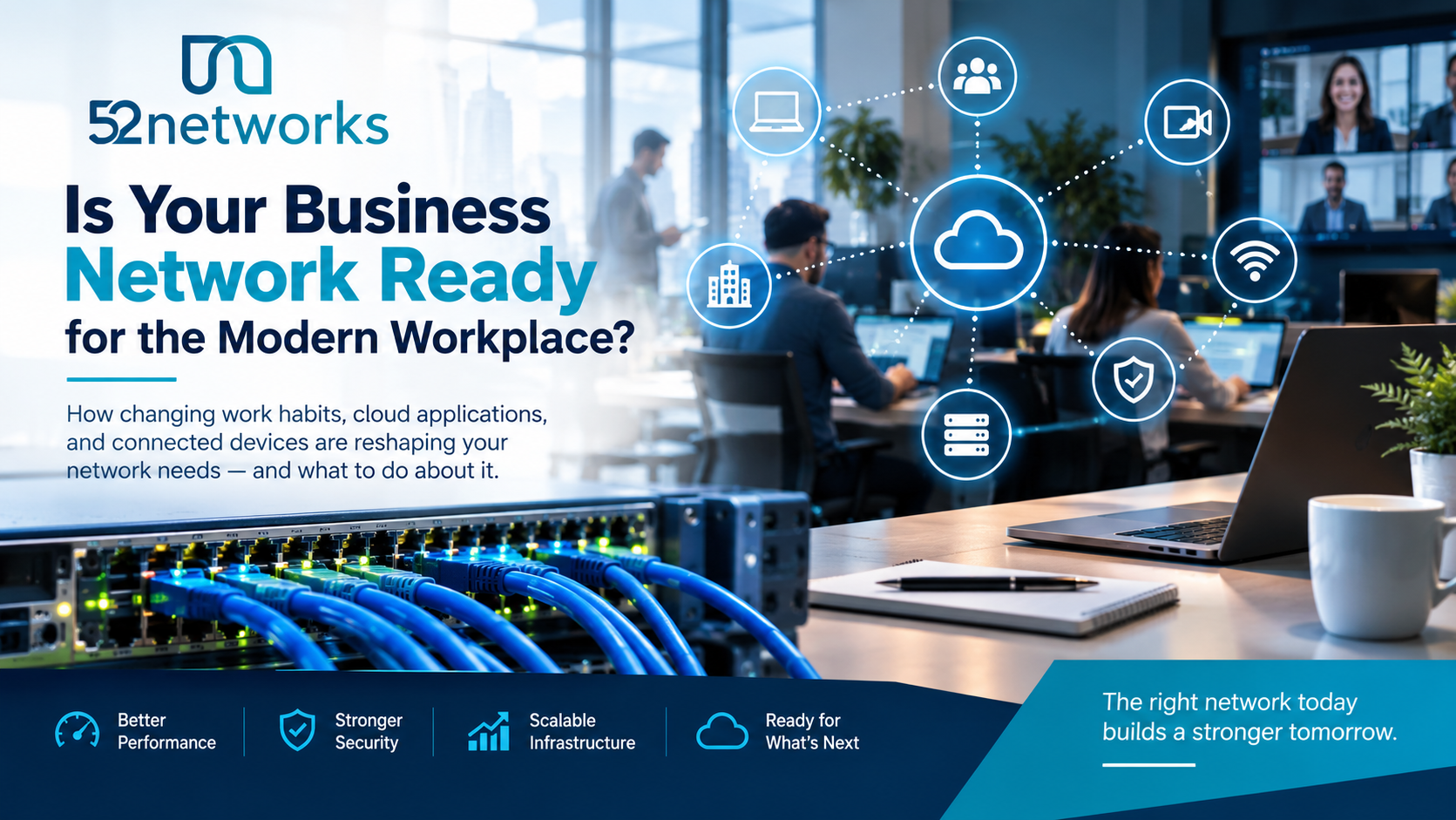
A few years ago, a typical office network had a relatively straightforward job. Employees worked from desktop computers, files were stored on local servers, and most business applications ran within the same building.
That picture has changed.
Today, employees may work from different locations, access cloud platforms throughout the day, join video meetings with customers, and use applications hosted outside their company's premises. Even businesses with a small physical office can depend on a surprisingly large number of connected services.
The challenge is no longer simply providing internet access. It is making sure the network can support the way people actually work.
The Modern Workplace Has Different Connectivity Needs
Consider a company with a sales team, a customer support department, and a small warehouse.
The sales team relies on cloud-based customer management software. Customer support uses voice calls and online service platforms. The warehouse depends on inventory systems and connected devices to keep operations moving.
Although these teams work for the same business, their network requirements are not identical.
A video call needs consistent performance. A large file transfer needs sufficient bandwidth. An inventory application needs dependable connectivity to avoid interruptions during daily operations.
Network planning becomes more effective when these differences are understood instead of treating every device and application as if they have the same priorities.
When a Small Problem Becomes a Business Problem
Network interruptions are often measured in technical terms: packet loss, latency, bandwidth, or connection failures.
For a business owner, however, the consequences are much more straightforward.
An employee cannot access a customer record. A payment system takes too long to respond. A meeting disconnects just as an important discussion begins. A team spends an hour waiting for a system to recover.
These problems may appear minor individually, but repeated interruptions can affect productivity and customer experience.
This is why businesses should evaluate their networks based on how well they support everyday operations, not simply whether a connection appears active.
Why Adding More Equipment Is Not Always the Answer
When a network begins experiencing problems, buying additional equipment can seem like the quickest solution.
But more hardware does not automatically produce better performance.
A business might install another wireless access point without first checking whether the existing wireless channels are congested. It might upgrade its internet connection while the real problem lies within its internal network. It might replace a switch without investigating the configuration or connection that is causing the interruption.
A better starting point is to understand the problem.
When did it begin? Which applications are affected? Does it happen to everyone or only certain users? Is the problem limited to a particular location?
Answers to these questions help IT teams identify the actual cause and avoid spending money on upgrades that do not solve it.
The Value of Visibility
One of the most useful improvements a business can make is gaining a clearer view of its network.
That does not necessarily require an expensive monitoring platform. Even a small IT team can benefit from maintaining an accurate equipment inventory, recording important network connections, reviewing device logs, and documenting recurring problems.
For larger environments, network monitoring tools can provide information about utilization, availability, latency, and unusual traffic patterns.
The objective is to identify changes before they become serious disruptions.
If a network connection regularly reaches its capacity during working hours, that information can support a planned upgrade. If a particular device repeatedly disconnects, technicians can investigate it before the problem spreads to other users.
Planning for the Next Stage of Growth
Business growth often creates networking requirements that were difficult to predict during the original installation.
A company may open another office, move employees into a larger workspace, introduce a new inventory platform, or add connected equipment to its operations.
A useful network plan should account for these possibilities without assuming that every future technology needs to be purchased immediately.
The practical priorities are straightforward:
- Understand the number and type of devices the business currently supports.
- Identify applications that require consistent connectivity.
- Review available network capacity and equipment limitations.
- Keep accurate records of existing connections.
- Make upgrades when there is a clear operational reason.
This approach allows businesses to spend on improvements that address actual requirements rather than following technology trends without a defined purpose.
Connectivity Is Part of the Business Experience
Customers may never see a company's network equipment, but they experience the results.
They notice when an online service responds quickly, when staff can retrieve information without delay, and when transactions proceed smoothly.
Employees notice the same things. A dependable network allows them to concentrate on their responsibilities instead of repeatedly dealing with technical interruptions.
For businesses reviewing their networking infrastructure, the important question is not simply how fast the network can operate under ideal conditions.
It is whether the network performs consistently during the hours and situations that matter most.
A More Practical Approach to Networking
Reliable connectivity begins with understanding the business, its applications, and the people who depend on them.
Equipment selection should follow that understanding. Network cables, switches, routers, wireless access points, and other connectivity products all have a role, but each should be selected according to the requirements of the actual environment.
52Networks provides networking products and connectivity supplies for different business and infrastructure applications.
Explore the available products at 52Networks.com.
For businesses planning a network upgrade, the most useful first step is to identify what is working, what is causing problems, and what needs to change.
A well-planned improvement can be more valuable than a complete replacement.
Conclusion
The modern workplace continues to change, and business networks have to adapt alongside it.
Reliable connectivity is not achieved through equipment alone. It comes from understanding how a company operates, identifying the problems that affect its people, and making thoughtful decisions about its infrastructure.
When network planning starts with real business needs, technology becomes more useful, maintenance becomes more manageable, and future improvements become easier to justify.
That is the kind of network investment that makes a difference long after the installation is complete.



Responses (0)