
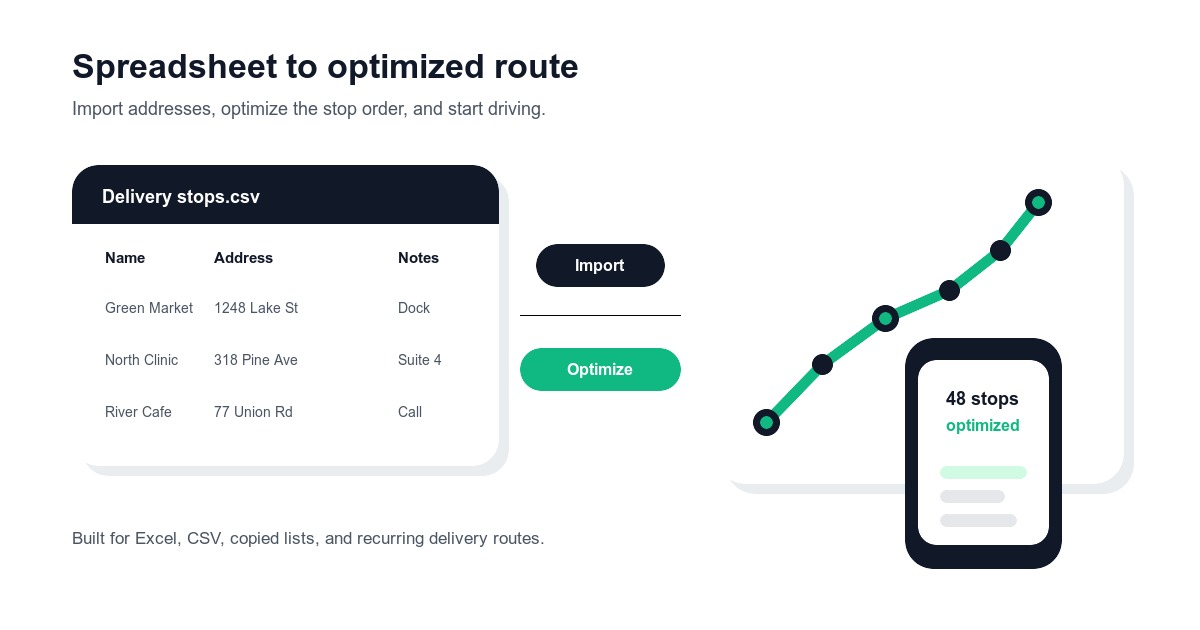
The first problem in a delivery route is often hidden in the spreadsheet, not on the road. A driver knows that “rear loading bay” is different from the customer's shopfront, but route software cannot infer that from a postcode alone. Importing two hundred addresses into a delivery route planner without checking the data may produce an impressive map full of stops in the wrong places. A short preparation pass can save more time than a complicated optimisation setting.
Give every delivery a unique order identifier. Keep street address, unit number, city, postal code, contact instructions and delivery window in separate fields where possible. Removing duplicates needs care: two parcels going to the same building may be different orders, and merging them could lose a signature requirement. Standardise abbreviations only when doing so preserves the meaning. A shop name is useful context, but the navigation point should identify where the driver can actually stop.
After importing a small test batch, inspect pins that fall outside the expected region. Geocoding can fail when a unit number is entered as the street number or when an industrial estate has several entrances. Correct the source spreadsheet, not just the displayed map, so the next import is clean. For a complex customer site, store practical delivery notes: gate access, security desk hours or a permitted unloading area. Keep personal details to what operations genuinely require.
Optimisation settings should reflect reality. A van that cannot use a low bridge or restricted road needs an appropriate vehicle profile where the software supports it. A timed business delivery should not be placed after closing, even if that shortens the calculated driving distance. Estimate service time for each stop rather than assuming that every drop takes the same thirty seconds. Parking, lift access and proof-of-delivery tasks often matter more than the nominal distance between consecutive addresses.
Driver feedback is essential. Someone on the route may know that a street is blocked on market days or that a particular loading area is impossible before noon. Record those observations as actionable data. They should influence subsequent planning where appropriate, but not turn into permanent rules after one unusual day. Measure planned versus actual arrival times by stop type and region; the discrepancy will show which assumptions need changing.
A good spreadsheet includes a field for exceptions that cannot be represented by a normal street address. This could be a designated gate, a timed freight lift or a phone call required before arrival. Make those notes concise enough for a driver to read safely while stopped. If a site has several entrances, consider whether its navigation point should be a loading entrance rather than the centre of the building. That small distinction can prevent a large detour in dense urban areas.
After the pilot, study failed deliveries separately from late deliveries. A missed signature, locked access door or absent recipient is not the same kind of problem as slow travel. Different causes need different changes: better appointment data, corrected address notes or more realistic service-time assumptions. A route optimiser should improve the entire delivery workflow, not simply rearrange dots until the map looks efficient.
Route data should be reviewed periodically, because a clean spreadsheet does not stay clean forever. Customers move, entrances change and delivery windows are revised. Add a way for drivers to flag stale notes without overwriting the original order record. The operations team can then approve corrections and update the master address data. This creates a feedback loop between the people planning routes and those navigating the last few metres to the delivery door.
A sensible pilot starts with one familiar route and one messy route. Compare total duty time, missed windows and the number of manual corrections, then review the results with the drivers. The aim is not to create a perfect-looking map. It is to produce a plan that survives traffic, building access and the realities of delivering goods to people.
The search term “delivery route planner” covers several possible products or services, so the actual specification and scope should be confirmed before making a selection.
Official website: Drivance







Responses (0)